

The Southern Pudu (Pudu puda) is one of two species of Pudu Deer native to South America. Their native range is across southern Chile and south-western Argentina. This deer is classified as near-threatened.
The Pudu is the smallest species of deer in the world, with the Northern Pudu Deer slightly smaller than its southern cousin.
How Small is the Southern Pudu Deer?
- Head & Body Length – 90 cm
- Shoulder Height – 35 cm
- Weight – 10 kg
What Does the Southern Pudu Look Like?
The Southern Pudu is the smallest of all the deer species, and is one of the smallest of the ungulates.
It is similar in appearance to the Northern Pudu, the main physical difference being that the Southern Pudu is smaller.
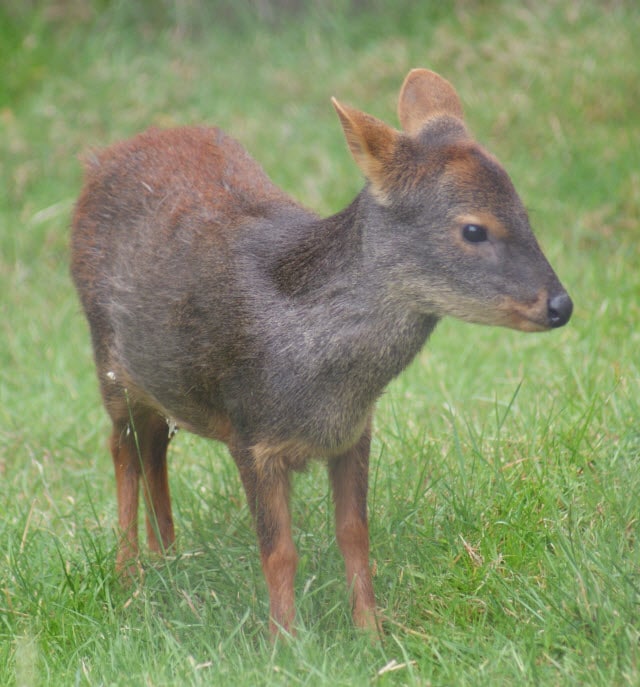
The coat is thick and rough, and in color it is a brownish black color.
The tail is short, and the ears are small and rounded. The antlers are small simple spikes. The antlers are cast in July and August, and begin to be regrown immediately.
The pre-orbital scent glands of the Pudu puda are large and prominent in this species of deer.
Where Do Pudu puda Live?
Distribution
The Southern Pudu lives in South America, where it has a more southerly range than the Northern Pudu. Its native range is in the southern Andes of Chile and south western Argentina.
Habitat
The Southern Pudu is more adaptable and flexible in the types of habitat in which it will live than is the Northern Pudu.
It lives on high mountainsides of up to 2,000 metres, but it can also be found at much lower altitudes, including along the coast.
Rather than living in open habitats, it prefers woodlands and forest that offer it a good degree of cover from predators. It will however, venture out into more open habitats to feed.
Mating Habits & Reproduction
Because this species lives at a fairly low latitude, its lifestyle is influenced by the seasons. The reproductive cycle of Pudu puda is seasonal.
The rutting period for these tiny deer occurs in early Autumn, in the months of April and May.
After a 200 to 210 day long gestation period, usually a single fawn is born.
Fawns have a brown coat that is spotted with white. This acts as camouflage from predators.
The young are weaned at 3 months of age, and become sexually mature when they are about a year old.
Behavior Unique to the Southern Pudu
The Southern Pudu lives in small family groups. It uses traditional pathways through thick vegetation, which over time become similar to small tunnels.
Pudu puda live in small territories. It is a shy secretive animal, and it normally feeds in the early morning or in the late afternoons.
They have a number of natural predators.


