

One of the largest deer species in the world, the Red Deer (Cervus elaphus) is a majestic animal that inhabits most of Europe, and Caucausus mountain range, parts of Asia, Iran, and Northwestern Africa (where it’s the only species of deer) on the continent. They are also found in North America, where they are called Elk or Wapiti.
If you’re curious how this large species measures up against one of Europe’s smallest deer, see our roe deer vs red deer comparison.
Conservation efforts have helped to preserve and expand the presence of the Red Deer, a wide-ranging species which has been introduced to many different locations around the world.
How Big are Red Deer?
- Head & Body Length – 165 to 260 cm
- Shoulder height – about 120 cm
- Tail length – 12 to 20 cm
- Weight – 100 to 350 kg.
What Does Cervus Elaphus Look Like?
The Red Deer is a large impressive looking animal. The males look especially majestic when they have a full crown of antlers, and have long been associated with virility and strength.
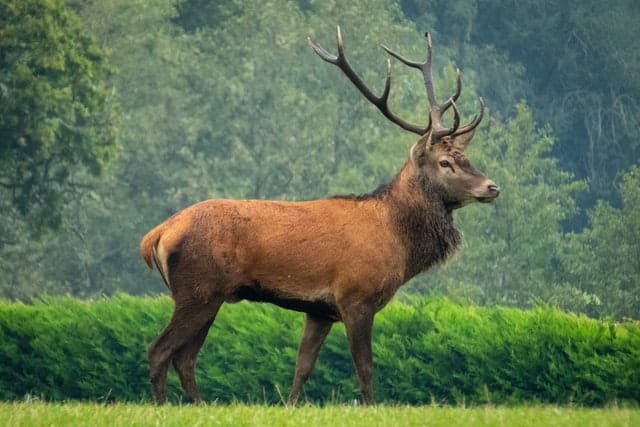
Although they are a large animal they are well proportioned. The body is slender and is carried by long legs. The neck is long and thin and the head graceful.
Males are considerably larger and more heavily built than the females of this species. The size and weight of Red Deer varies considerably across their geographical range, in Western Europe animals are much smaller than those found further east.
Male red Deer are known as Stags, while the females are known as hinds.
Coloring
Coloring of the Cervus Elaphus changes with the seasons.
- During the summer months the coat is a rich reddish brown color, and is sleek and shiny.
- The winter coat grows in October or November and is much longer and rougher in appearance, and is mostly a drab greyish color.
The winter coat is moulted each year at the beginning of spring around May. The under parts are usually a paler color than the upper parts of the coat, as is often the head. There is no distinct rump patch although the hairs of the rump may be slightly paler than those of the back.
Physical Characteristics
The ears of Red Deer are large, oval in shape, and ending in a pointed tip.
The Red Deer’s eyes are black, and are positioned well up on the head allowing this species excellent visibility.
The tail is short in length, and the same color as the rest of the coat.
Like most species of deer the Red Deer has a number of glands around its body, with the pre-orbital ones below the eyes being the most prominent and noticeable.
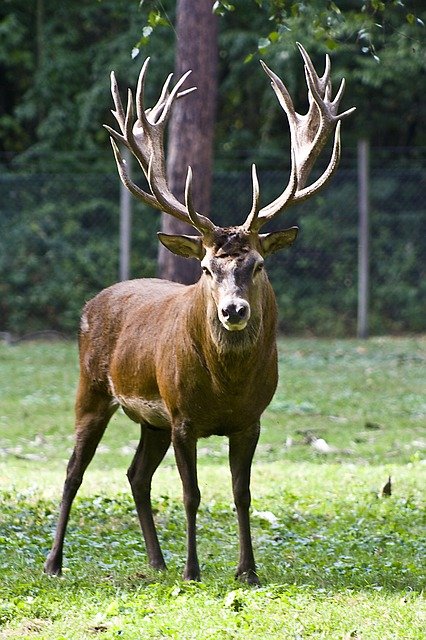
Only stags have antlers. The antlers are used by the males when fighting with each other for access to females during the annual mating season or rut.
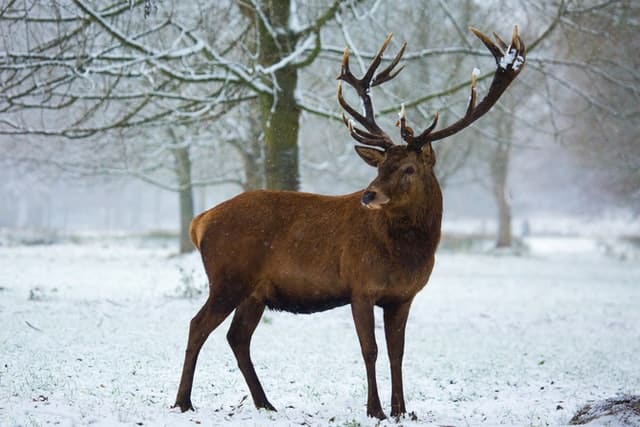
The antlers are lost after the rut each January, but males begin to grow a new set almost immediately. They shed their antler velvet once the antlers are ready for use by the following August.
Mature Red Deer can possess very impressive sets of antlers. The antlers are branched and have many tines. A typical fully-grown male will possess antlers with a total of 12 tines, but animals with as many as 20 tines are not unheard of.
Young stags, and stags from areas with poor levels of food will not develop antlers of full size.
Where do Red Deer Live?
The Red Deer has one of the most widespread distribution ranges of any species of deer.
They are found across a broad swath of temperate forest across Europe and Asia, and into North America.
In North America they are often called Wapiti or Elk. They are also the only species of deer to be found in Africa, with a small population living in the Atlas Mountain range.
Preferred Habitat of Red Deer
Red Deer are inhabitants of open deciduous woodland and forest. They prefer woodland areas that have many open glades and clearings where they can find enough food to support their large bodies. They are also often found in mountainous areas where they can feed at and above the tree line.
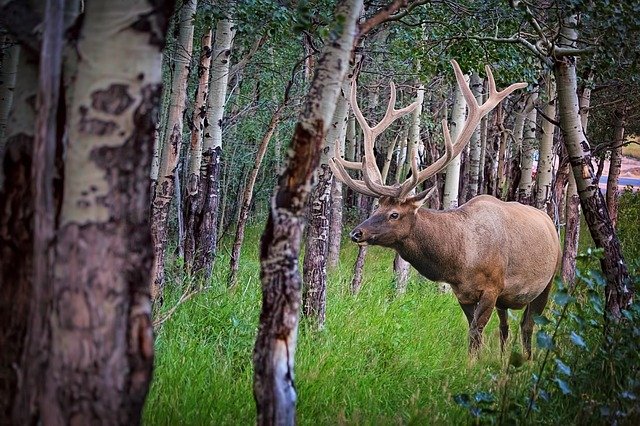
Although across most of its range they are woodland living, in some places they have adapted to living in different kinds of habitats.
For example, Red Deer in the Atlas Mountains of North Africa live in semi- desert mountain conditions.
In Scotland, Red Deer have adapted to live on open moorlands.
A famous population of Red Deer lives on the island of rum.
Diet
Red Deer feed mostly on various types of grass, but they supplement this diet with various types of herbaceous plants, twigs, shoots, and mosses.
The composition of their diet depends to a certain extent on the season and which foods are available at any given time.
How Long do Red Deer Live?
In captivity Red Deer can live to be over 20 years of age, but wild living Red Deer have a maximum lifespan of about 12 years.
Few animals are older than 8 or 9 years of age. The oldest deer ever was a domestic Red Deer named Bambi.
The Rut for Red Deer
The Red Deer breeding season is known as the rut, and takes place in Europe between October and December.
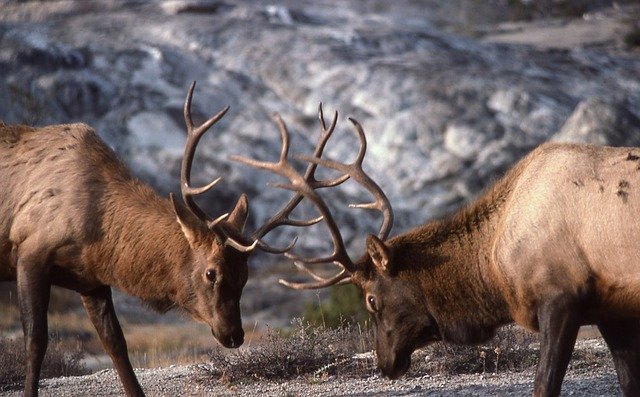
Males reach peak condition for the rut, their antlers ready for use and bodies are flowing with male hormones.
During the rutting season males are more aggressive and more active than at other times of the year. Males compete fiercely for the right to breed with females, with only the strongest and most powerful males winning the opportunity to reproduce.
Gathering a Harem
The stags attempt to collect together a harem of females with which to mate.
Other stags challenge males in possession of a harem, and this can take place in a number of different ways. The first way in which stags ‘measure up’ each other is by bellowing.
Bellowing
Rival males bellow at each other, the males who can bellow the longest and deepest are perceived to be the strongest.
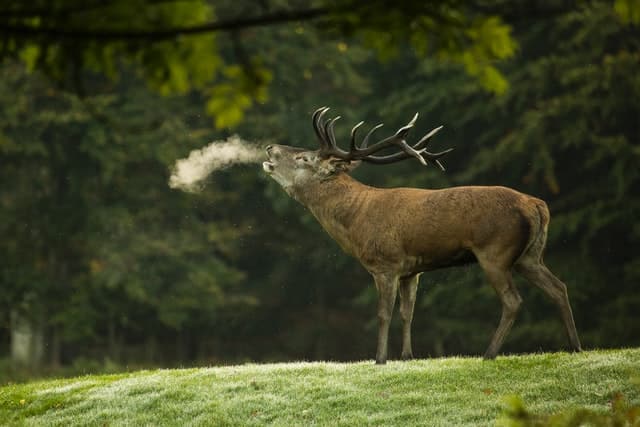
These bellowing contests can last several hours, but are a good indication on how strong the opponent is.
There is little point in a male continuing a contest further if it is obvious that he is weaker than the dominant animal.
Sizing Up the Competition
A challenging stag will also walk next to a dominant stag, both animals sizing each other up. If the challenger believes he is not strong enough he will discontinue the challenge and walk away.
A Duel
If the challenger believes he is strong enough to beat the dominant male, then the males will fight with their antlers. They lock their heads together and attempt to push each other back. Both animals try to use their weight to force the other animal off balance.
These fights can be very aggressive, as both animals are usually fairly closely matched in size and strength. The fights can result in severe injury or even in death. If one of the stags succeeds in forcing his rival to lose his balance he may ram his flanks with his antlers, a maneuver which can cause nasty injuries.
To the Victor Go the Spoils
Eventually one of the stags emerges as the winner, and the loser retreats, leaving the winner in possession of the harem.
As you can imagine this takes up a lot of energy, and males quickly lose condition during the rut. Some males may lose so much energy that they do not have the resources or stamina to survive the winter which follows mating season.
Cervus Elaphus Offspring
Red Deer have a pregnancy of about 220 to 240 days long. Young animals are usually born at the end of May or the beginning of June. Normally only a single young is born, but on occasion twins will be born to Elk.
The newborn young have brown colored coats that are dappled with white spots. These help to camouflage the calf in thick vegetation. For the first few days the calf lies hidden in thick vegetation, and is visited regularly by its mother to be fed.
When the calf is strong enough it begins to accompany its mother back to the main herd. The calves are suckled for about 6 months, and usually remain with their mothers until they are about a year old and the mother gives birth again.
Unique Behavior & Habits of the Elk
The Red Deer is a social animal and spends most of its life living in herds.
There are separate stag ‘bachelor’ herds and female herds. Males and females lead separate lives for much of the year, only coming together during the annual mating season.
The female herds are made up of small family units of a female and her young. Within the female groups there is a strict dominance hierarchy, with one female being the boss. Dominant animals decide where the herd will go and where it will feed.
The bachelor herds are much looser in structure than the female herds. There are no strong bonds between any of the animals. These herds are composed of males of a variety of ages. Old males may become more solitary in behavior and wander off alone.
Red Deer are rather sedentary in behavior and do not migrate or move around to any great extent.
Most feeding takes place during the early mornings and late evenings, while the middle of the day is used for resting and digesting food.
Red Deer are very alert animals. In Western Europe their main predators have been exterminated, but in the east of their range and in North America predation is still a real threat, with bears and wolves being the main predators.
With that said, predators will mostly take young animals. Older Red Deer can normally escape preadators because of their speed and agility.


