

Native to the river valleys of China, the Pere David Deer (Elaphurus davidianus) is sometimes referred to as the Milu or the Elaphur.
It is the only living member of the genus Elaphurus, and as a result it occupies a unique spot on any list of different types of deer around the world.
This beautiful deer species was hunted to complete extinction in China during the end of the 19th century, but was saved because several specimens had been brought to zoos in Europe. Père David’s Deer was bred successfully in captivity and European nobles eventually donated several dozen to the Chinese government, who reintroduced it to its native homeland.
Currently there are estimated to be about 700 Pere David Deer living in China.
Pere David Deer Size
- Head & Body Length – 140 to 230 cm
- Shoulder height – 130 cm
- Tail length – up to 60 cm
- Weight – Males up to 200 kg, Females up to 115 kg.
History of the Père David’s Deer
Pére David’s Deer have a fascinating and unusual history, becoming extinct in the wild in their native home, but being saved due to captive breeding by a British Aristocrat.
The Pére David’s Deer was discovered by western science in 1865. The Jesuit Priest and famous French biologist, Armand David was visiting China and heard about an unusual animal kept in the Emperors private garden known as the Forbidden Palace, to which there was no access.
He bribed some guards and was able to study the animals, which he thought was a type of Reindeer and which subsequently were named after him.
These animals had already become extinct in there natural home in the wild, and only survived in the emperor’s private collection. Some years later the Chinese Emperor gave a small number of the deer as a present to France, Germany and Britain.
Although the deer in France and Germany soon died out, the British animals fell into the hands of the Duke of Bedford, who kept the animals on his Woburn estate. Here the animals thrived and a successful herd remains to the present day.
However, the animals did not fare so well in their native home, becoming extinct in the Forbidden Palace in 1939. Other herds were established using animals from the Woburn herd, and now Pere David Deer are a common zoo and park animal. Some have been returned to China.
What Does the Pere David Deer Look Like?
As well as having an unusual story, Pére David’s Deer are also an unusual and strange looking species of deer. They have been described as being a mixture of a number of different animals in the past, reflecting their unusual mixture of features.
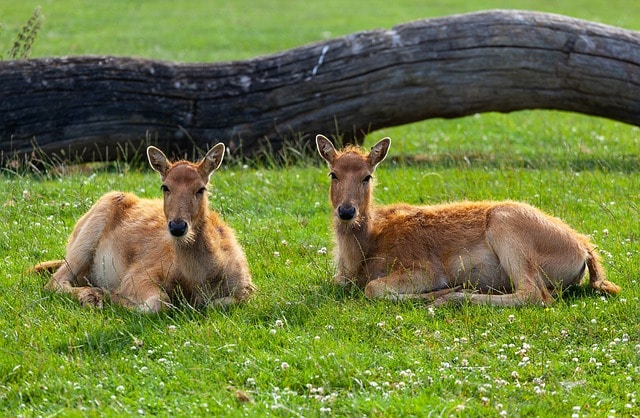
The head is long, while the neck is short. There is often a thick mane of hair around the neck and shoulders.
The legs are rather long, and give it a rather lanky and ungainly appearance.
The tail is long and has been described as being ‘donkey like’.
As well as its unusual stature, the antlers are also unlike those of any other species of deer, most easily described as being ‘back to front’. The antlers point backwards.
They are short but strong looking, with two distinct shafts. They have several tines. The antlers are cast from October to December, and new ones begin to grow straight away, taking 6 months to reach full size before the velvet is shed.
On the head of the Pére David’s Deer are very prominent pre-orbital glands.
The coat is a brown color during the winter months, and is redder in the summer.
The hooves are wide and widely sprayed, and like the Reindeer as the animal moves they make a loud clicking sound.
Where Does Elaphurus davidianus Live?
Originally the Pére David’s Deer was found across a large area of China. However, because of habitat loss and over hunting it became extinct in the wild.
Today it is found only in parks and zoos, and does not occur in the wild, except where re-introduced in China.
Pere David Deer Habitat
Pere David’s Deer was originally an inhabitant of marshy and swampy areas of land. You could find it close to rivers and other forms of water. It preferred areas with thick undergrowth where it could hide and retreat from danger.
Its wide hooves are well-suited to this type of habitat. They allow the deer to move easily over soft and muddy ground.
But as China’s population grew, the Pere David’s Deer habitat disappeared, with agriculture slowly destroying the deer’s natural habitat.
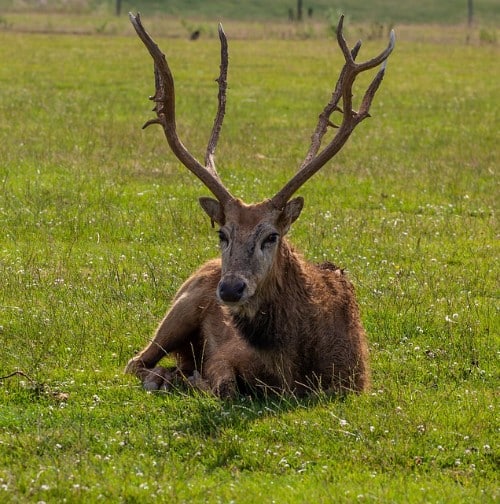
Luckily Elaphurus davidianus has adapted well to living in captive herds, and is now often kept in open woodland areas or parkland environments.
Mating Habits
The rut occurs relatively early compared to the mating habits of other deer. It takes place in June and July.
Males leave the herds prior to the beginning of the rut. They will then try to collect together small harems of females, which they compete over.
This deer’s pregnancy lasts about 270 days, with normally one or two calves born in May.
Pere David Deer calves are a brown color, with numerous white spots for camouflage.
Lifespan of Elaphurus davidianus
Pere David Deer have a lifespan of up to 25 years.
Since the majority of these deer live in captive herds, they have little risk of predation. Many are long-lived and may reach this advanced age.
How long a deer lives is highly dependent on their environmental conditions and domestic deer outlive their wild counterparts.
Unique Behavior & Habits
Outside of the rut, Pere David’s Deer live in large mixed sex herds. These groups of deer are led by a few dominant animals. The leaders decide where the deer will gather, eat, sleep, or where it will travel.
This kind of deer has no fixed territories. The exact behavior of Pere David’s Deer in the wild is unknown since it was extinct in the wild. What little is known about Elaphurus davidianus behavior is gleaned from observing captive herds.