
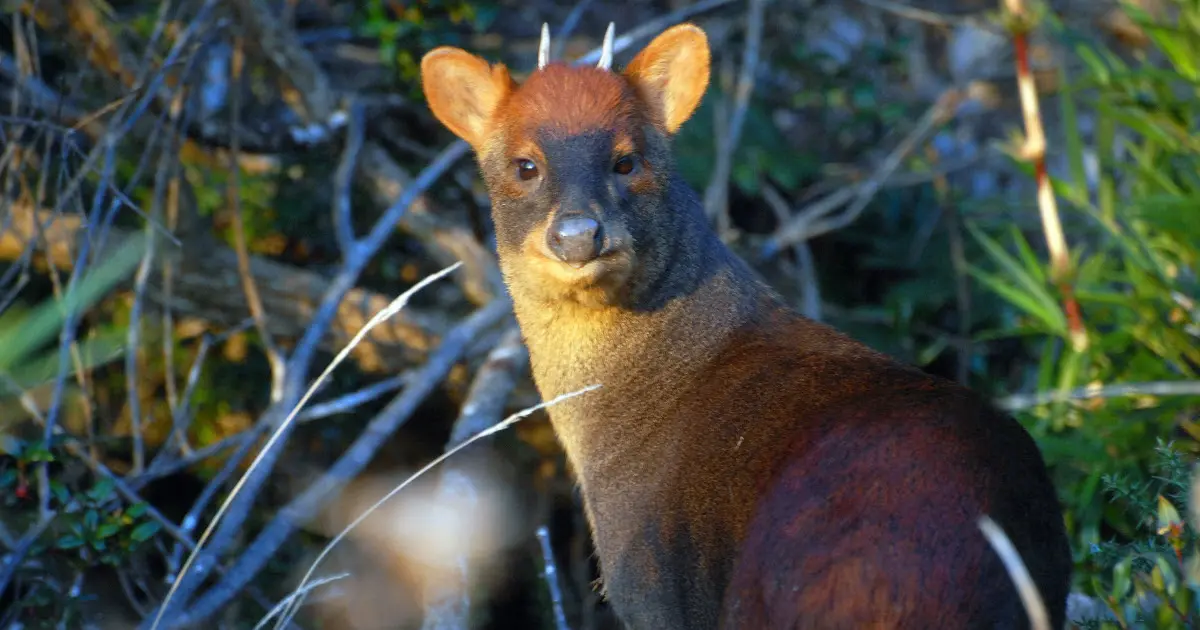
The Northern Pudu (pudu mephistopheles) is the smallest type of deer in the world and typically weighs less than 13 pounds when mature.
Northern Pudu deer have a compact, rounded body and inhabit the Andes Mountains in Columbia, Ecuador, and Puru, prefering to live high above the sea level in a temperate rainforest where there is plenty of forage.
Northern Pudu Size
| Head & Body Length | 60 – 80 cm |
| Shoulder Height | Up to 35 cm |
| Tail Length | 2 – 3 cm |
| Weight | 8 – 10 kilograms |
Learn More About the Northern Pudu (pudu mephistopheles)
Physical Appearance
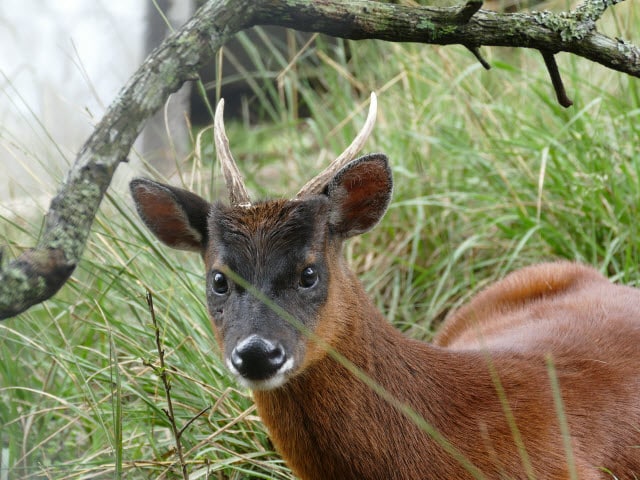
The Northern Pudu is a small species of deer, only slightly larger than the Southern Pudu. It has a small rounded body, thin delicate legs, and short spike like antlers.
The coat is dark brown in color, and is thick and dense, offering good protection from the harsh elements of the habitat in which it lives.
The ears of pudu mephistopheles are small and rounded, and the tail is short. The pre-orbital glands are small.
The antlers are only short simple spikes.
There are two species of Pudu, the Northern one is smaller than the Southern species and it lives in different habitats than its southern counterpart.
Where Does the Northern Pudu Live?
This small deer lives in the South American countries of Ecuador and Peru where it is found on the Paramos and Punas regions. It has a more northerly distribution than the Southern Pudu.
Habitat of the Northern Pudu Deer
This small deer lives on high mountain slopes and steppe lands, mostly at altitudes of between 3,000 and 4,000 metres in height.
You’re unlikely to see one, and certainly you will not see the pudu mephistopheles at lower elevations (unlike the Southern Pudu). This pudu prefers open habitats without much cover. It prefers high grasslands and scrublands.
Breeding & Reproduction
Little is known about the reproductive life of this species. It is thought that the pudu mephistopheles males may be territorial, and mate with the females present within their territories.
After a 200 day long gestation period, normally a single young is born to the pudu mephistopheles. The fawn is un-spotted unlike the young of the Southern Pudu and many other deer.
Pudu young stay with their mother until they are about a year of age, when they become sexually mature.
Behavior
As of yet, little is known about the behavior and lifestyle of this animal.
The Northern Pudu is shy and secretive, and because of the difficult terrain in which it lives, research into it has been hindered and is extremely difficult.
This small deer appears to live either alone or in small pairings, in small territories.
Pudu Mephistopheles Diet
The Northern Pudu feeds mainly on grasses and herbaceous plants which it finds within the habitat in which it lives.
Predators and Daily Life
Even at 3,000 meters and above, a tiny deer is never entirely safe. The puma ranges through the northern pudu’s mountain home, and the culpeo — the largest of the Andean foxes — is a real threat to a deer this small, especially to fawns. Around villages and pastures, free-roaming domestic dogs add another danger, chasing and killing pudus just as they do other small Andean wildlife.
The northern pudu’s whole way of life is built around not being noticed. It moves quietly along regular trails through tussock grass and shrubs, feeds mostly in the calmer hours of early morning and evening, and freezes at the first hint of danger before darting into cover. This hide-first strategy is common to small deer everywhere, and it is a big part of why so little firsthand behavioral observation of this species exists.
Is the Northern Pudu Endangered?
The IUCN Red List currently classifies the northern pudu as Data Deficient — scientists simply do not have enough reliable information to judge its population size or trend. Earlier assessments listed the species as threatened, and most researchers still assume it is declining across parts of its range in Colombia, Ecuador, and Peru. The main pressures are believed to be:
- Habitat conversion, as high-elevation grasslands and forest edges are burned, grazed, and plowed for agriculture
- Free-roaming dogs, which chase, kill, and can spread disease to wild deer
- Hunting, both for meat and opportunistically
- Livestock competition on the páramo pastures the pudu depends on
Because the species lives in cold, remote, fog-draped terrain, surveys are difficult and expensive, and camera traps are only beginning to fill in the blanks. Better data is the first step toward better deer conservation for this elusive animal.
One Species or Two?
There may be more to the northern pudu than meets the eye. Some taxonomists have recently proposed that what we call the northern pudu actually comprises more than one species, with the population in Peru’s mountain forests distinguished from the animals of the páramos farther north in Ecuador and Colombia. If that view is confirmed, each newly separated population would be even smaller than currently thought — raising the conservation stakes for all of them.
How the Northern Pudu Compares to Other Andean Deer
The Andes host a surprising cast of deer, and the northern pudu is the smallest member by far. The taruca shares the same general high-altitude world of grassy slopes above the tree line, but it is many times heavier, lives in social groups, and carries forked antlers. Farther south in Patagonia lives the South Andean deer, or huemul, a stocky forest-edge deer with no range overlap with the pudu. Where these larger deer rely on herds or rugged terrain for safety, the pudu bets everything on staying hidden.
Frequently Asked Questions
Is the northern pudu the smallest deer in the world?
The two pudu species are together regarded as the smallest deer on Earth, and many sources give the northern pudu the edge as the smallest of all: published weights for wild animals are often in the range of just 3 to 6 kilograms (7 to 13 pounds), though reported figures vary from source to source. Either way, no other deer species comes close to the pudus at the miniature end of the scale.
Can you see a northern pudu in a zoo?
Almost certainly not. Unlike the southern pudu, which is kept and bred in zoos around the world, the northern pudu is virtually absent from captivity. The pudus you see in zoo collections are, as a rule, southern pudus. Seeing a northern pudu means traveling to the high Andes — and getting very lucky.
What is a páramo?
The páramo is the cold, humid alpine ecosystem of the northern Andes, lying between the upper limit of the mountain forest and the permanent snow line. It is a landscape of tussock grasses, cushion plants, and hardy shrubs, frequently wrapped in mist — and it is the signature habitat of the northern pudu.
Related species: Compare this mountain miniature with its forest-dwelling cousin the southern pudu, or meet the Andes’ larger deer, the taruca.