Mule deer (Odocoileus hemionus) are the big-eared deer of western North America, ranging from the Yukon and southeastern Alaska to central Mexico. Typical Rocky Mountain bucks stand 33–42 inches at the shoulder. Globally Least Concern; widely hunted; many herds sit below agency goals.
Updated on September 7, 2026
This is the deer most people west of the 100th meridian mean when they say “deer.” It is a shrub-and-basin animal that learned sage, aspen, oakbrush, and the Front Range suburb. Among the world’s deer species, it is the one whose ears, rump patch, and stiff-legged bound are the field ID — and whose winter range, draw tags, and chronic wasting disease numbers now sit closest to western daily life.
Mule deer facts
Numbers in this table wear a source. Size is more even across the range than in white-tailed deer, but a Sitka blacktail on a Southeast Alaska island and a northern Rocky Mountain buck are still the same species, not the same animal. Black-tailed deer are subspecies of mule deer, not a third wild species.
| Fact | Figure | Source |
|---|---|---|
| Scientific name | Odocoileus hemionus | IUCN Red List |
| Shoulder height | 84–106 cm (33–42 in) for males; 80–100 cm (31–39 in) for females | Animal Diversity Web |
| Weight range | About 43–150 kg (95–330 lb) overall. North Dakota: bucks average 170 lb (125–330); does average 140 lb (110–210) | ADW; North Dakota Game and Fish |
| Range | Western North America west of the 100th meridian, roughly 23° to 60° N: Yukon and southeastern Alaska through the western United States into central Mexico and Baja | ADW; USFS FEIS |
| Conservation | Least Concern globally (population trend: stable). Many western herds are below state or provincial objectives | IUCN 2016; WAFWA 2026 rangewide status |
| Hunted? | Yes. In the 2024–25 season Montana reported the most antlered mule deer harvested (33,627). Wyoming hunters took 16,688 mule deer in 2025 | NDA 2026 Deer Report; WGFD 2025 harvest report |
How to tell a mule deer from a white-tailed deer
Where the two species overlap — the Great Plains, the Rockies’ eastern slope, river bottoms in Wyoming and Colorado, and parts of the Southwest — people mix them up. Coat color will lie to you. Both go gray-brown in winter. The fastest field checks are the tail, the ears, the antlers, and the way the animal runs. The full side-by-side is on mule deer vs. whitetail deer; the short version is here.
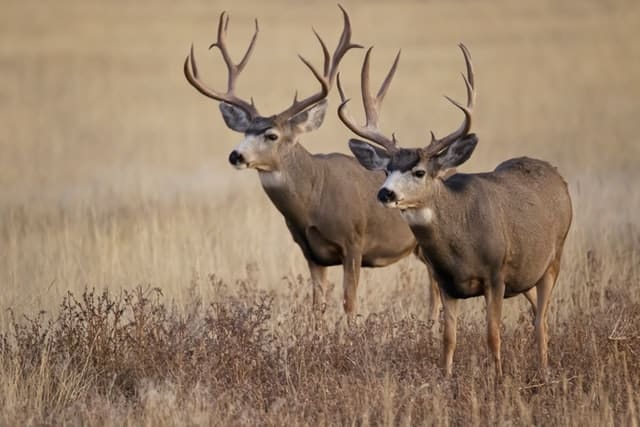
- Tail. A mule deer carries a thin, rope-like tail, usually white with a black tip, against a large pale rump patch. It does not flag. A white-tailed deer carries a broad brown tail with a white underside; when it blows out, that tail goes up. That flag is the namesake.
- Ears. Mule deer ears are oversized — mule-like, which is the name. Animal Diversity Web notes they are conspicuous enough to be a field character on a gray face. Whitetail ears are smaller and sit lower on a browner face.
- Antlers, if it is a buck. Mule deer forks: each beam splits, and the forks can split again (dichotomous). A typical mature mule rack is counted as a 4×4 in the western system. Whitetail tines rise off one main beam. Yearlings of both species can look messy. Do not age a deer by point count; that argument belongs on antlers.
- Gait. Press a mule deer and it often stots — a stiff-legged bounce with all four feet leaving the ground together. A whitetail gallops, head down, flag up, and is gone into the next timber finger. Speed numbers live on how fast deer run; the useful field fact is the style, not a radar gun.
The two can hybridize where ranges meet. The U.S. Forest Service Fire Effects Information System review, citing Geist and others, treats wild hybrids as uncommon and notes that hybrid survival is poor in captivity and in the wild. In the field, treat an odd-looking deer on the plains as a reason to look again, not as a third species.
Two other mix-ups are common and they are not the same mix-up. On the Pacific slope, Columbian and Sitka blacktails are subspecies of this species. They carry a darker, broader tail instead of the rope-and-black-tip. That split is on blacktail deer vs mule deer. In Arizona and New Mexico the other small gray deer on the next ridge is often a Coues deer — a desert subspecies of white-tailed deer, not a small mule. Tags there can name only one of them. The field and legal comparison is Coues deer vs mule deer.
Elk and moose are not lookalikes. A bull elk stands about five feet at the shoulder; a moose is larger still. If the animal in front of you is horse-sized, it is not a mule deer. The size-and-rump comparison is on deer vs elk. On open sage, the tan animal with no antlers in summer and a white rump that is not a deer at all is a pronghorn; that is deer vs pronghorn.
Range and habitat
Mule deer are native to western North America. Animal Diversity Web puts the usual eastern edge from southwestern Saskatchewan through central North and South Dakota, Nebraska, Kansas, and western Texas, with isolated records farther east. The FEIS list of jurisdictions is the cleanest map in words: Alaska, Arizona, California, Colorado, Idaho, Kansas, Montana, Nebraska, Nevada, New Mexico, North Dakota, Oklahoma, Oregon, South Dakota, Texas, Utah, Washington, and Wyoming in the United States; Alberta, British Columbia, Manitoba, Northwest Territories, Saskatchewan, and Yukon in Canada; plus Mexico south onto the Mexican Plateau and Baja, including some islands in the Sea of Cortez.
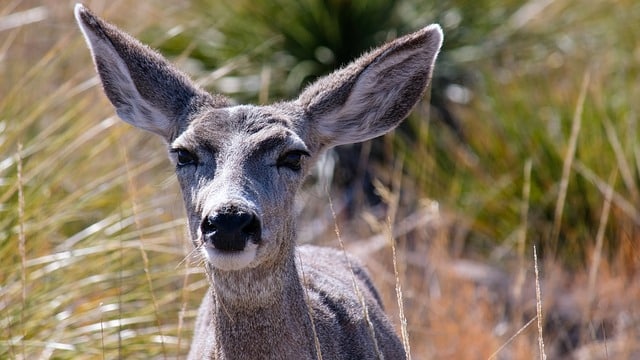
Major gaps sit in the Mojave and Sonoran deserts, parts of northeastern Arizona and southeastern Utah, California’s Central Valley, and the Great Salt Lake desert. The species occupies nearly every other western biome north of central Mexico except arctic tundra. That is not a single habitat. Rocky Mountain deer live by aspen, oakbrush, and a sage winter slope. Great Basin deer live in sagebrush, saltbush, and pinyon-juniper. Southwest deer use desert shrub, dry washes, and upper bajadas; they are scarce on shrubless desert grassland. Plains deer stick to river breaks, badlands, and shrubby draws, not level tallgrass. Pacific-coast blacktails live in Sitka spruce, western hemlock, Douglas-fir, and California oak-chaparral. Sitka blacktails are the Alaska animal; interior Alaska does not hold mule deer the way the Yukon’s south-facing grassy slopes do.
The FEIS taxonomy splits the species into a mule-deer group and a black-tailed-deer group. The mule group includes Rocky Mountain mule deer (O. h. hemionus), California, desert (eremicus), southern, and peninsula mule deer, plus the island forms on Cedros and Tiburón whose status as subspecies is in doubt. The blacktail group is Columbian black-tailed deer (O. h. columbianus) and Sitka black-tailed deer (O. h. sitkensis). Genetic work cited in that review finds a mitochondrial split between the mule group and the blacktail group, not a clean split between Columbian and Sitka. Translocations have mixed some of those lines. Treat the groups as useful field and hunt geography, not as three species.
Size follows that geography. FEIS: the largest mule deer occur in the Rocky Mountains; the smallest are blacktails on the northern Pacific coast. Roosevelt National Forest field-dressed carcass weights in one cited sample averaged 148 pounds for bucks 1.5 years and older and 118 pounds for does. Lake County, California, blacktail bucks in good condition typically ran 90 to 130 pounds. A northern farm-country whitetail buck can match a Rocky Mountain mule buck on the scale. The ears and the tail still tell you which one it is.
Many mountain herds migrate. FEIS reviews put migration distances from under a mile to nearly 100 miles (about 2–160 km). Not every deer in a herd moves. In the Green River Basin of western Wyoming, about 95 percent of mule deer were migratory. In Rocky Mountain foothills of eastern Colorado, only 7 percent of females migrated. North-central Colorado populations in one synthesis averaged 52 percent migratory, ranging from none to all. USGS movement work later put average migrations around 10 miles in Colorado and 31 miles in Wyoming — averages, not the longest documented corridors. Individuals generally keep the same summer and winter ranges year after year. Snow about 12 inches deep starts to impede travel, especially for fawns; that is when a high basin empties toward a south slope or a windswept ridge. In the arid Southwest, some deer shift with rainfall instead of snow. Prairie mule deer often stay put and change habitats locally. The migration essay is do deer migrate; this page is the species version of that split.
Home ranges are not small woodlots. FEIS reviews put mean annual home ranges from 74 to 34,220 acres. Open, simple, variable country produces large ranges; closed, diverse, stable country produces smaller ones. Males range farther than females. Adult females with fawns shrink. Winter snow can pin a Bridger Mountains herd onto less than 20 percent of its year-round range. In Middle Park, Colorado, snow deeper than 18 inches made more than 90 percent of winter range unusable in two of three winters in one classic study. That winter bottleneck — not the pretty August basin — is the habitat that actually sets how many mule deer a mountain can carry.
Diet by season
A mule deer is an intermediate feeder: woody browse and herbaceous forage in roughly equal measure over the year, not a grass specialist and not a pure browser. Animal Diversity Web, following Short, is blunt about the winter trap. Diets of woody twigs alone cannot meet maintenance. Optimum growth depends on highly digestible, succulent forage. The species runs an annual metabolic cycle: higher intake and energy flux in summer to grow and store fat; lower flux in winter to survive on poorer forage without burning the fat too fast. Estimated intake is about 22 grams per kilogram of body weight per day. Adult bucks drop intake hard when the rut starts. The wild-diet picture across deer is on what do deer eat; the seasonal pattern below is the mule version.
Spring. Green-up. Does are pregnant or newly lactating. Deer hit new forbs, emerging leaves, and the first succulent shrub growth — bitterbrush, mountain mahogany, aspen, ceanothus, depending on the range. In the Southwest, spring forage tracks winter and early-summer rain as much as calendar. This is also when a Front Range hosta bed becomes a protein bar. If you are trying to keep plants in mule-deer towns, start here: deer eat hostas, often to the ground, and they are not browsing them by accident.
Summer. Forbs, shrub leaves, aspen, oak, and mountain meadows. Green leaves are mostly digestible cell contents; dead, weathered leaves are not. Fawns nibble vegetation within days of birth. Heat and, in desert units, water push feeding toward dawn, dusk, and the north-slope shade. FEIS notes that in Maricopa County, Arizona, summer home ranges can shrink around limited water. That is a diet-and-water problem, not a treestand problem.
Fall. Mast and cured forage. Acorns, legume seeds, and fleshy fruits where they exist; oakbrush and bitterbrush on a lot of the map; waste grain on plains edges. This is also the rut. Bucks spend more time walking and less time eating. On the Pacific slope, blacktails are in timber and clearcuts, not sage. The hunt implication of that split belongs on blacktail vs mule and on the Oregon and Washington state pages, not in a second diet list.
Winter. Sagebrush, bitterbrush, juniper, cliffrose, mountain mahogany, and whatever browse still sits above the snow. Conifers get used when herbaceous food is buried. Douglas-fir and ponderosa seedlings are acceptable forage; Animal Diversity Web records that as a real timber-regeneration conflict in the Douglas-fir region, not a curiosity. Deep snow that reaches about a foot makes travel expensive, which is why winter ranges are often a fraction of the summer map. Deer lose weight through a northern winter even on adequate browse; the question is how much, and whether the winter range was already a housing tract.
In towns, the seasonal menu is landscaping. Front Range and Great Basin suburbs see the same plants eastern yards do, just on a different species. Hostas, tulips, roses, arborvitae, and young fruit trees are reliable. The practical response is the fence-and-plant strategy on the deer-proof garden guide, not a spray bottle and a wish.
Reproduction and fawns
Mule deer are polygynous with a tending-bond system. A dominant buck tends an estrus doe until she is bred or he is displaced. Dominance is largely size; the largest bucks with the largest antlers do most of the breeding. FEIS also records the wandering-buck version of the same season: males search, does come into a short estrus, and yearling females tend to breed three to four weeks later than adults. True estrus lasts 24 to 36 hours. The interval between heats is about 22 to 29 days. As many as five estrous cycles can pass if a doe is not bred.
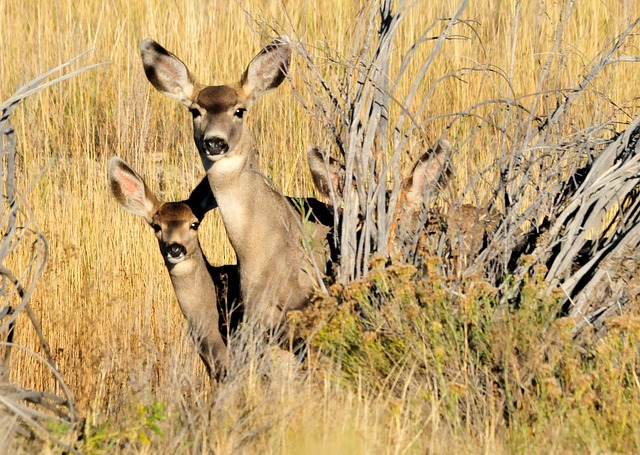
The northern peak is late November through mid-December. Animal Diversity Web puts most conceptions there. FEIS is wider on the calendar: as early as September and as late as March depending on location, but tight within a given place. In the Missouri River Breaks of eastern Montana, 75 percent of pregnant does conceived between 21 November and 1 December. Photoperiod sets the clock; nutrition can shift it. The phase-by-phase northern version of the season is on the deer rut explained and deer mating habits.
Average gestation is about 204 days (AnAge’s mean is 207). Peak births run mid-June to early July, with most in June. Robinette calculated that a 305-meter rise in elevation delays birth about seven days. That is why a high-country fawn can be a week or more behind a foothill fawn in the same state. Birth mass is 2 to 5 kg (about 4.4–11 lb), with males heavier and singletons heavier than twins. Adult does commonly produce twins; yearlings usually produce singletons; triplets and quadruplets are rare. In the Missouri River Breaks across 12 years, mule deer averaged 44 percent singletons, 55 percent twins, and 1 percent triplets. On the poorest range that flipped to 75 percent singletons; on the best, 70 percent twins and 3 percent triplets. Pregnancy rates in adult females often run 70 to more than 90 percent. Fawns conceiving is rare in the wild. The general fawn-count page is how many fawns do deer have; those Montana percentages are the mule-deer version.
Southwest production tracks rain. FEIS cites Hungerford: summer precipitation may be the strongest control on fawn production and survival in arid country. On the Kaibab Plateau, a dry summer produced 28 fawns per 100 does, the lowest on that record. That is not a Midwest mast story. It is a desert forage story.
A newborn is a fawn. Spots are camouflage in dappled light; they fade with the first winter coat. The naming question is what is a baby deer called. A female is a doe; that vocabulary is on what is a female deer called. Gestation across deer is on deer gestation period. Weaning begins around five weeks and is usually done by 16 weeks. If you find a fawn alone, it is probably not abandoned. Leave it. The how-to is what to do if you find a fawn. Spots: why fawns have spots and when fawns lose their spots. Newborn weights across species: how much a fawn weighs.
Social structure is a maternal clan: two or more generations of related females and their young. Bucks older than yearlings are not in those groups. Adult bucks may bachelor or go solitary. In late spring, adult females drive off last year’s young and isolate for fawning. Winter aggregations on restricted range can exceed 100 animals, especially in the north where snow shrinks the grocery. A group of deer is still just a group; the vocabulary page is what do you call a group of deer.
Antler cycle
Only males grow antlers in this species, with rare documented exceptions. If you are looking at a female with a rack, read do female deer have antlers before assuming she is a different animal. Reindeer are the deer in which both sexes routinely grow them; mule deer are not.
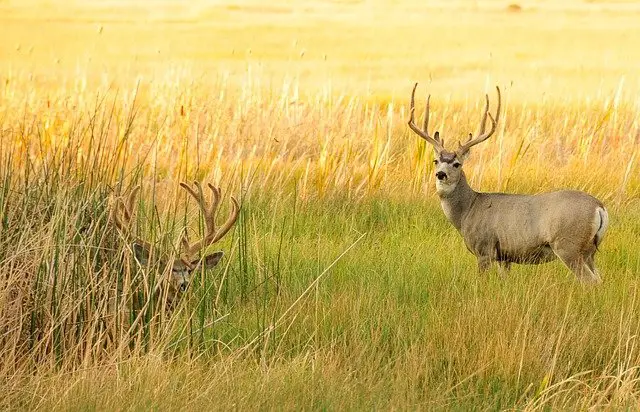
The annual cycle is a photoperiod story. Animal Diversity Web: day length acts on the anterior pituitary; growth hormones drive velvet antler; declining day length, gonadotropins, and androgens harden bone, strip velvet, and hold the antler as dead bone through the rut. Withdrawal of androgens after the breeding season lets bone resorb at the pedicel and the antler drops.
- Late winter. Hard antlers drop, often January through April, earlier for many mature bucks, later for some yearlings. Why they drop: why deer shed their antlers. Finding them: shed antlers.
- Spring. Pedicles swell; velvet-covered bone grows fast. Calendar: when deer start growing antlers.
- Summer. Velvet supplies blood. Diet and age set the ceiling, not the number of points alone. Antlers do not automatically get bigger every year. See do deer antlers get bigger each year and the overview at deer antlers.
- Late summer to early fall. Bone hardens; velvet is rubbed off. Velvet shedding is a few days of messy work, not a season.
- Fall. Hard antlers are tools for rank and for the rut. A typical mule rack forks, then forks again. Boone and Crockett’s typical mule deer all-time minimum is 190; that is a records number, not a field-age tag. A spike can be a yearling or a poorly fed older buck.
They grow back. That is the definition of antlers as opposed to horns. The short version is on do deer antlers grow back.
Predators
A healthy adult mule deer in open country is built to see you coming. Animal Diversity Web lists pumas, coyotes, bobcats, golden eagles, feral dogs, and black bears. Wolves take deer where wolves remain: the northern Rockies, parts of the Canadian range, and recolonizing pockets. The list of who actually kills fawns versus adults is on what eats deer.
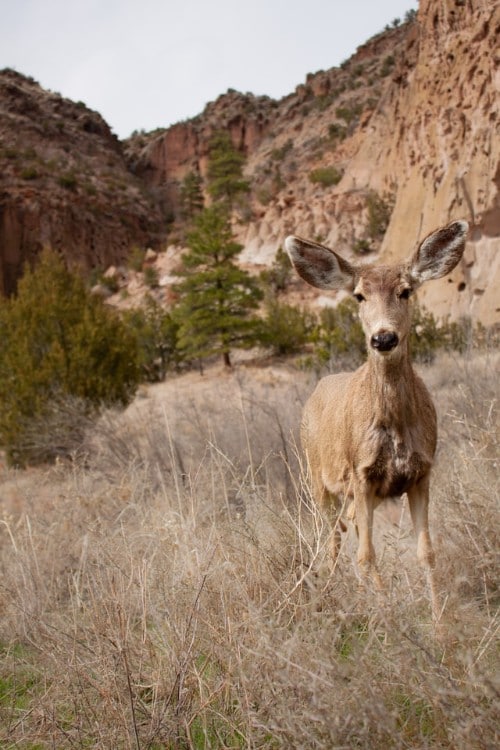
The deer’s answers are ears, eyes, and distance. ADW, following Geist: males can visually track another animal as far as 600 meters. They may hide, put cover between themselves and the threat, leave while the predator is still far off, or bound uphill so the chase costs more than it is worth. When a predator closes, they cut and use obstacles. That last trick fails against group hunters. They swim well; they rarely use water as an escape the way a whitetail will. Stotting is both locomotion and a signal. It looks wrong until you have seen it twice. Then it is the picture you remember.
People now kill more mule deer, in most of the range, than any wild predator does. That is management, not a footnote, and it belongs in the next section rather than in a hunt pamphlet wrapped around this page.
People: hunting, yards, roads, and disease
Mule deer are one of the most socially and economically important big-game animals in western North America. They are not the most numerous. The National Deer Association’s 2026 Deer Report (completed 2024–25 season) does not give a single continent-wide mule-deer harvest the way it does for whitetails. What it does give is the West’s scoreboard: Montana reported the most antlered mule deer harvested (33,627); Utah harvested the most antlered mule deer per square mile (0.28); Nevada harvested the most antlered mule deer per 100 deer hunters (34); Colorado harvested the most antlerless deer per square mile among those western states. Antlered mule-deer harvest in the West was up 10 percent in 2024. Those figures are agency harvest, not a census.
Herd status is mixed, and it is not the 1950s. The Western Association of Fish and Wildlife Agencies’ 2026 rangewide status of black-tailed and mule deer is the current agency compilation. Of 21 member agencies with mule deer, 4 reported increasing populations, 9 stable, and 8 declining. Black-tailed and mule deer populations are below agency goals in most jurisdictions. Wyoming is the clearest published example: after the 2025 season the Game and Fish Department estimated about 237,700 mule deer, 46 percent below a management objective of 437,600. WAFWA records that as an increase on a still-low base. Of 37 Wyoming herd units, 4 were at objective and 33 were below; none were over. An estimated 307,200 mule deer have been lost in that state since 2000. The 2025 Wyoming harvest was 16,688 mule deer (15,783 bucks). Colorado Parks and Wildlife’s northeast deer plans put a 2024 statewide deer estimate around 384,000, of which that region held about 53,000 — and most of Colorado’s deer west of I-25 are mule deer. State-by-state context, not a second harvest table, lives on mule deer population by state.
Hunting here is how most western states try to keep a productive buck age structure and, in some units, to hold chronic wasting disease down. It is not the subject of this page. The how-to hub is deer hunting. For a single-state picture of how a limited mule tag actually works — draw, leftover, sage, aspen, pack-out — use Colorado deer hunting or Wyoming deer hunting rather than treating this species profile as a season guide. Public dirt with a name on it: best public land for mule deer in Wyoming, plus unit pages that already exist for Black Hills, Medicine Bow, and Payette. Sibling western states if you are choosing a trip, not padding this page: Utah, Idaho, Montana, Nevada, Arizona, and New Mexico. Oregon and Washington split the species on a mountain crest: blacktail west, mule east — Oregon deer hunting and Washington deer hunting. The 50-state index is deer hunting by state. Public-land method is public land deer hunting.
In towns the conflict is browse and glass. A Front Range or Wasatch doe and two fawns can unmake a perennial bed in a night. The plants they prefer are not a mystery. Repellents buy time. Eight-foot fences and unpalatable planting keep it. That is the job of deer-proof garden, not of this encyclopedia entry.
On roads, the conflict is kinetic. Mule deer are crepuscular; most collisions happen at dusk, dawn, and after dark in fall, when the rut puts bucks on their feet in daylight they would otherwise skip, and again in spring when migration hits a fence line and a highway. Wyoming’s 2025 legislative mule-deer memo cited on the order of 5,500 mule deer struck on state highways each year and called that likely conservative. If you hit one, the practical sequence — safety, reporting, insurance, what not to do with a carcass — is what to do if you hit a deer.
Disease is the long problem. Chronic wasting disease is a prion disease of cervids, fatal, and now established in the core of mule-deer country. USGS, as of June 2026, documents CWD in free-ranging and/or captive cervids in 37 U.S. states and five Canadian provinces. A 2026 USGS Northern Rocky Mountain Science Center summary put observed spread from 2005–2022 at about 14 miles per year, faster in western regions (about 9–11 miles per year) than in the East (about 3). Wyoming Game and Fish tested 5,370 elk, deer, and moose samples in 2025 and detected CWD in 842. Statewide prevalence in hunter-harvested mule deer bucks averaged 21.6 percent, up from 19.4 percent in 2024. As of 31 December 2025, CWD had been found in 35 of 37 Wyoming mule-deer herds and 111 of 127 mule-deer hunt areas. Colorado Parks and Wildlife, in an April 2025 commission update, had detected CWD in 42 of 51 deer herds. Prevalence had decreased in 4 herds, increased in 14, and stayed about the same in 16. You cannot diagnose CWD from a truck window with certainty. Field signs, testing logic, and what not to do with a carcass are on CWD deer symptoms and how to get your deer tested for CWD.
Lifespan in the wild is short for most individuals. Hunting, winter, vehicles, coyotes, and CWD remove the young and the old first. Wyoming’s 2025 focal-herd program, as summarized in WAFWA, averaged 80 percent annual survival for adult females, 61 percent for adult males, and 70 percent for juveniles. Animal Diversity Web puts a captive mean around 22 years. The broader deer-family numbers are on how long deer live; weights across species are on how much a deer weighs.
Mule deer compared with other deer
If you are booking a western mule hunt instead of a Midwest farm-timber sit, the tag, terrain, and shot-window comparison is on mule deer vs. whitetail deer.
Comparisons that already exist on this site. Use them instead of a second species page:
- Mule deer vs. whitetail deer — the native lookalike. Tail, ears, antlers, gait, and habitat. If you hunt or watch deer west of the Missouri, start there.
- Blacktail deer vs mule deer — same species, different subspecies group. Pacific slope versus interior West. Not a third wild species.
- Coues deer vs mule deer — the Southwest mix-up. Coues are tiny desert whitetails. Some Arizona and New Mexico hunt codes name only one.
- Blacktail deer vs. whitetail deer — almost no shared range. The Pacific-coast blacktail hunt is not a whitetail hunt with rain.
- Deer vs elk — elk are much larger, herd animals with a straw rump and a September bugle. Not a lookalike.
- Deer vs pronghorn — pronghorn are not deer. They share sage with mule deer and confuse people who only have a rump patch to go on.
Within this species, treat Columbian and Sitka blacktails as geography, not as separate encyclopedia animals, unless you are on the vs-page. Treat Coues deer as a white-tailed deer subspecies page, not as a mule.
FAQ
These questions already have their own pages. The lines below are the pointer, not a rewrite.
Are black-tailed deer a different species from mule deer?
No. Columbian and Sitka black-tailed deer are subspecies of Odocoileus hemionus. They are the Pacific-coast group of this species. Field marks and the hunt split: blacktail deer vs mule deer.
How do you tell a mule deer from a whitetail?
Tail, ears, antlers, gait. Mule deer: rope tail with a black tip, big ears, forked antlers, stot. Whitetails: broad flagging tail, smaller ears, tines off a main beam, gallop. Full table: mule deer vs. whitetail deer.
Are Coues deer small mule deer?
No. Coues deer are white-tailed deer, Odocoileus virginianus couesi. They share mountains with mule deer in Arizona and New Mexico. Tags can be species-specific. Coues deer vs mule deer.
Do mule deer migrate?
Many mountain herds do; many plains and some foothill deer do not. Distances run from under a mile to nearly 100 miles. Green River Basin Wyoming: about 95 percent migratory. Eastern Colorado foothills: about 7 percent of females. Details: do deer migrate.
How much does a mule deer weigh?
It depends on sex, age, and geography. Animal Diversity Web’s overall range is about 95 to 330 pounds. Rocky Mountain bucks run larger than Pacific blacktails. Across-species table: how much does a deer weigh.
Do mule deer have chronic wasting disease?
CWD infects mule deer, whitetails, elk, and moose. It is established in much of the West. Wyoming’s 2025 hunter-harvested mule-deer-buck prevalence was 21.6 percent. Testing and field signs: CWD deer symptoms.
Sources
- Sanchez-Rojas, G. and Gallina-Tessaro, S. 2016. Odocoileus hemionus. The IUCN Red List of Threatened Species 2016: e.T42393A22162113. Least Concern; population trend stable. Assessed 16 December 2015.
- Innes, Robin J. 2013 (last updated 18 June 2025). Odocoileus hemionus, mule deer. Fire Effects Information System, U.S. Forest Service. Taxonomy, distribution, reproduction, migration, home range, diet context.
- Misuraca, M. 1999. Odocoileus hemionus. Animal Diversity Web, University of Michigan. Shoulder height, mass 43–150 kg, gestation ~204 days, birth timing, intake, predators, captive lifespan.
- North Dakota Game and Fish Department. Mule deer. Shoulder height, live-weight bands, stotting, gestation.
- Western Association of Fish and Wildlife Agencies, Mule Deer Working Group. 2026. 2026 Rangewide Status of Black-tailed and Mule Deer. Agency trend counts; Wyoming post-2025 estimate 237,700.
- Wyoming Game and Fish Department. 2025 deer harvest report (16,688 mule deer) and 30 March 2026 news: 5,370 CWD samples, 21.6% prevalence in hunter-harvested mule deer bucks, 35 of 37 mule deer herds.
- National Deer Association. January 2026. 2026 Deer Report. 2024–25 western mule-deer harvest highlights including Montana 33,627 antlered mule deer.
- U.S. Geological Survey. CWD distribution current to June 2026 (37 U.S. states, five Canadian provinces) and 2 September 2026 NOROCK summary of spread rate and migration distances.
- Colorado Parks and Wildlife. April 2025 CWD update (42 of 51 deer herds) and 2024–25 northeast deer herd plans (statewide deer estimate ~384,000).
- Boone and Crockett Club. Minimum entry scores. Typical mule deer all-time minimum 190.
Updated on September 7, 2026