

Indian Muntjac deer (Muntiacus muntjak) is native to Southeastern Asia. Also called the Southern Red Muntjac or Barking Deer, and is among the smallest deer species.
Males have short antlers which branch only once and long canine teeth that act as tusks. They also have large scent glands on their head, which they use to mark their territory.
On this page we will provide facts and information about Indian Muntjac deer and introduce you to this unique species.
What Size is the Indian Muntjac?
- Head-Body Length – 70 to 80 cm
- Shoulder Height – 30 to 40 cm
- Weight – 15-20 kg
What Do Indian Muntjac Deer Look Like?
The Indian Muntjac looks a lot like all Muntjac species of deer. It is a small and delicate looking animal. The body is small and compact, and the legs short and slender.
Males are slightly larger than female Indian Muntjac.
Muntiacus muntjak is often called the Common Muntjac in addition to its more usual name of the Indian Muntjac deer.
Distinctive Features
The most distinctive feature of the Indian Muntjac are the bony facial ridges it has. These are from the bony bases of this deer’s antlers, called the pedicles. These extend down the forehead and onto the deer’s face.
Pedicles and Antlers
The pedicles for antlers are often longer than the antlers themselves in this type of deer. Although only the males grow antlers, the bony pedicles are present in both male and female Indian Muntjac deer.
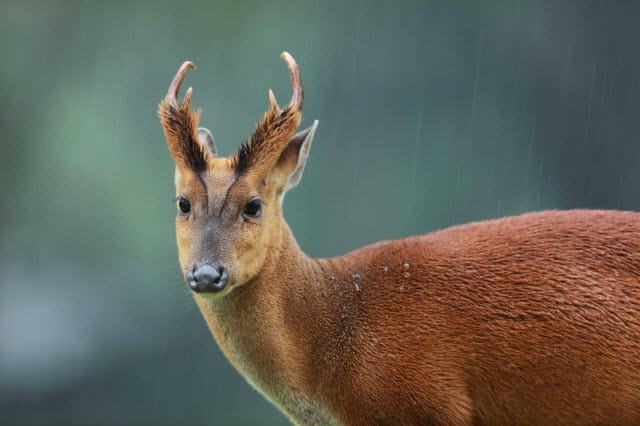
Only males grow antlers and these grow to only about 15cm in length and are short simple spikes. Sometimes the antlers have a single branch. The antlers are lost at regularly intervals by the males and regrown, but unlike in temperate living deer species there is no defined season for this to occur.
Tusks
The preferred weapon of the males are not the antlers but the their long canine teeth. The upper canine teeth are large, and they look like short tusks. These grow outwards from the lips in a distinct curve. They use these for fights between male Common Muntjac Deer.
Coat & Coloration
The coat is made up of short soft hairs. The coat ranges from a greyish-brown to a dark brown in color. Sometimes there are creamy white patches.
Head & Face
The head is small but the muzzle relatively long. Around the ears there is little hair. The pre-orbital tear glands found just beneath the eyes of the deer are well developed.
An unusual feature of the Indian Muntjac is its long tongue, which it can use to lick its face and ears.
Barking Deer
The Indian Muntjac is an alert little animal, and when startled it emits a short barking alarm call which has earned it the name “Barking Deer.”
They will continue to give out these calls for some time after danger has passed, sometimes for more than an hour.
Muntjac Subspecies
There are 15 subspecies of Indian Muntjac. These are:
- Muntiacus muntjak annamensis of South East Asia ,
- M.m.malabaricus of India,
- M.m.aureus also of India,
- M.m.bancanus which is found on the Billiton Islands,
- M.m.curvostylis which is found in Thailand,
- M.m.grandicornis of Myanmar,
- M.m.montanus known as the Mountain Muntjac of Sumatra,
- M.m.muntjak the Javan Muntjac of Java,
- M.m.nainggolani the Bali Muntjac,
- M.m.nigripes The Black-footed or Black-legged Muntjac found in China and Vietnam,
- M.m.peninsulaeo of Borneo and Malaysia,
- M.m.pleicharicus of Java,
- M.m.robinsoni of the Bintin Islands and Linda archipelago in Indonesia,
- M.m.rubidus of Borneo, and
- M.m.vaginalis which is found in Myanmar and southern China.
Where Does Muntiacus muntjak Live?
Distribution
The Indian Muntjac is the most numerous species of Muntjac deer. They have a large distribution and you can find them in the wild from India eastwards across south eastern Asia as far as Indonesia.
These deer occur as far north as parts of Southern China. The countries they are found in include India, Sri Lanka, Nepal, Myanmar, Thailand, Vietnam, Malaysia and the Indonesian islands of Java, Sumatra and Borneo.
Preferred Habitat
These deer inhabit areas of tropical forest. Muntiacus muntjak prefer areas that have thick and dense cover in which they can easily hide from man and predators.
The Indian Muntjac is not at any conservation risk, and in some places it is considered to be a pest because it will feed on agricultural crops and damage trees by feeding on the bark.
Lifespan
In captivity they have a maximum lifespan of about 10 years, but in the wild this deer’s lifespan is much lower.
Diet
They feed on a variety of forest foods, including leaves, shoots, forest fruits and forest mushrooms.
Mating & Reproduction in Indian Muntjac Deer
Breeding can take place at any time of year in this species. The young are born after a 200 to 220 day long gestation period.
Normally only a single baby deer (called a fawn) is born. Mothers seek out locations with good cover to deliver their fawns. The young remain hidden in thick vegetation for the first few weeks of their life, before beginning to venture out with their mothers.
At birth the young weigh about a pound. They are weaned at 2 to 3 months of age, and become fully mature from about 12 months of age. When they are fully-grown the young deer are forced to leave there parents territory and find one of there own.
Notable Behavior
The Indian Muntjac usually lives alone, but sometimes a male and a female will form a pair bond and live together.
They are a territorial species of deer, and mark the boundaries of their territory with secretions from their pre-orbital eye glands. Males will vigorously defend their territories and the females that it contains from rival males.
Sometimes fights between the males will take place over these territories, and during these fights severe injuries can be caused.
The Indian Muntjac is mostly nocturnal in habit. It has a number of natural predators.
Muntjac Watching: Tips and Gear
To maximize your chances of spotting an Indian Muntjac, heading out at dawn or dusk can be particularly fruitful, as this is when they are most active.
Understanding Muntjac Vocalizations and Sounds
One intriguing aspect of the Indian Muntjac that might pique your interest is their communication. Vocalizations, particularly the well-known bark, is used to alert fellow deer to danger. It’s fascinating to learn that this call can vary in intensity and frequency, indicating different levels of threats or social interactions.
The Role of Scent Marking
Aside from auditory signals, scent marking is a critical component of muntjac behavior. Males have preorbital glands, which they use to mark their territory by depositing scent on twigs and branches. This behavior not only defines their space but also conveys vital information to other muntjacs, such as social status or reproductive condition.
Adaptability and Resilience: How Muntjacs Cope with Environmental Changes
Indian Muntjacs are notably adaptable creatures. They can inhabit a wide range of environments from lowland rainforests to high-altitude regions. Their ability to survive in fragmented habitats underscores their resilience in the face of human-induced environmental changes and is a testament to their evolutionary success.
Understanding Indian Muntjac Population Dynamics
Research into Indian Muntjac populations provides insight into their social structures and survival strategies. Interestingly, despite their territorial nature, these deer can live in relatively high densities when conditions are favorable, which has implications for their management and conservation.
Tracking and Study Techniques for Indian Muntjacs
Wildlife biologists often use camera traps and GPS collaring to study the Indian Muntjac. These non-invasive techniques offer a glimpse into their secretive lives, providing data on their movements, behaviors, and interaction with the ecosystem without disturbing the animals.
Indian Muntjac and Human Interaction
While the Indian Muntjac is elusive, it is not uncommon for them to venture near human settlements. Understanding how muntjacs adapt to living near people, and the challenges this presents, is essential for mitigating potential conflicts and for the planning of conservation strategies.
Exploring the Economic Impact of Indian Muntjacs
While the Indian Muntjac is not typically known for causing significant agricultural damage, it is important to explore their impact on local economies. This includes potential crop foraging behavior and how communities manage their presence to prevent any negative effects.
If you’re curious about other members of the deer family, you might enjoy learning about the differences in antler structure in brow tine deer, or perhaps understanding a deer’s body language, like what it means when a deer stares at you. Delving into these topics not only enriches our knowledge but fosters a greater appreciation for the creatures we share our planet with.


