

Fallow deer (Dama dama) are medium-sized Old World deer. Mature bucks grow palmate, shovel-shaped antlers; adults keep a black-edged white rump and one of four coat colors. The only confirmed native wild population lives in southern Turkey; people moved the rest.
Updated on September 7, 2026
This is the park-and-woodland deer of Europe, not a North American native. Among the world’s deer species it sits in the Old World subfamily Cervinae with red deer, sika, and axis. The endangered cousin is the Persian fallow deer (Dama mesopotamica). If the animal in front of you might be a Texas white-tailed deer instead, the field marks live on fallow deer vs whitetail.
Fallow deer facts
| Fact | Detail |
|---|---|
| Scientific name | Dama dama (Linnaeus, 1758) |
| IUCN | Least Concern globally because introductions are widespread. The only undoubtedly natural wild population, in southern Turkey, is under serious threat. |
| Shoulder height | Bucks about 0.9–1.0 m (35–39 in); does slightly smaller. Animal Diversity Web |
| Mass | Free-ranging bucks 46–80 kg (avg. 67 kg); does 30–50 kg (avg. 44 kg). ADW. The British Deer Society puts UK bucks at 46–93 kg. |
| Antlers | Palmate on mature bucks, typically 50–70 cm. ADW. BDS: palmation usually from the third or fourth set; full potential by six or seven years; up to 0.7 m. |
| Coat | Four named morphs: common (chestnut, spotted), menil (paler, spots persist), melanistic (nearly black), and white. ADW calls this the most variable pelage of any deer. |
| Gestation | BDS: 229 days. ADW: 231–245 days (33–35 weeks). Usually one fawn in June or July. |
| Native remnant | Düzlerçamı / Mount Güllük–Termessos, Antalya, southern Turkey. IUCN 2008 assessment. |
| U.S. status | Exotic ungulate. Texas: no state bag or closed season on private property; license and landowner permission still required. TPWD exotic species |
How to identify a fallow deer
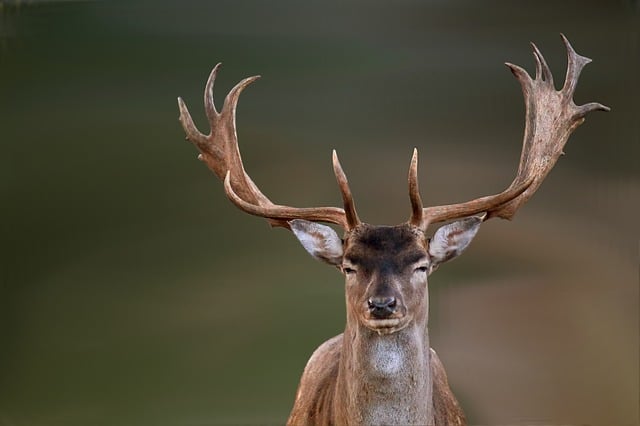
Start with the rack, then the rump, then the coat. A mature buck carries the only palmate antlers among British deer and, in North America, the only shovel-shaped rack besides moose. The upper beam flattens into a blade; tines stick off the palm like fingers. Yearlings grow a spike. Palmation develops with age — see the antler cycle below, and the broader biology on antlers.
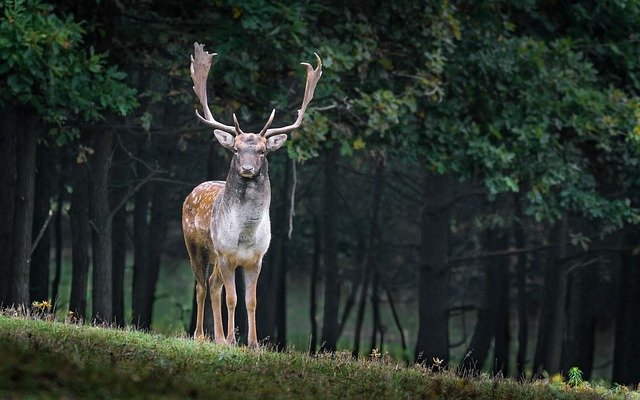
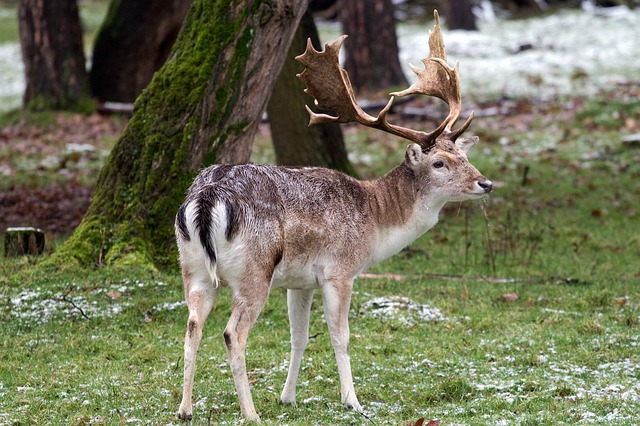
The rump is a large white disk with a black border — BDS describes a black inverted horseshoe — and the tail is long with a black stripe down the top. BDS notes that fallow tails are the longest of any British deer. Does bark a short alarm. Bucks groan in the rut, a belch-like sound from a stand, not a red-deer roar and not a Maryland sika scream.
Common (chestnut) animals wear a spotted summer coat; spots fade or vanish in the darker winter coat, which molts around April or May. Menil animals stay paler and keep spots. Melanistic animals look nearly black; spots are faint or gone. White animals are a true color morph, not albino. A black adult in a Texas pasture is almost always a melanistic fallow, not the rare eastern melanistic white-tailed deer.
Lookalikes: adult whitetails are unspotted and flag a white tail underside. Axis keep bright white spots year-round and grow lyre-shaped three-point antlers, not palms — that split is on axis vs whitetail. Sika keep a heart-shaped white rump and a whistle; they overlap fallow in some European woods and, as ranch stock, in Texas. The marsh ID is on sika vs whitetail. Persian fallow are larger, with less palmation; they are not the Texas ranch animal.
Range: a Turkish remnant and a human map
IUCN lists European fallow as Least Concern because Phoenicians, Romans, and later park keepers spread it. The same assessment is blunt about origin: the only undoubtedly natural wild population survives in the Düzlerçamı / Termessos area of southern Turkey, and that native stock is under serious threat. A 1966 Turkish breeding program at Düzlerçamı grew from seven animals to more than 500 by the mid-1980s, then collapsed under urbanization, recreation, and poaching (Masseti and Mertzanidou 2008, citing the Turkish program). That remnant is why a globally common deer can still be a conservation problem at home.
Britain is the park story. Finds at Fishbourne Roman Palace show fallow in southern England in the 1st century AD. BDS reports those Roman animals went extinct after the empire collapsed; fallow were reintroduced in the 11th century from the eastern Mediterranean, kept for venison, then escaped as parks declined. They are now the most common deer in England, per the Mammal Society, widespread in Wales, and patchy in Scotland. Only red and roe are truly indigenous there.
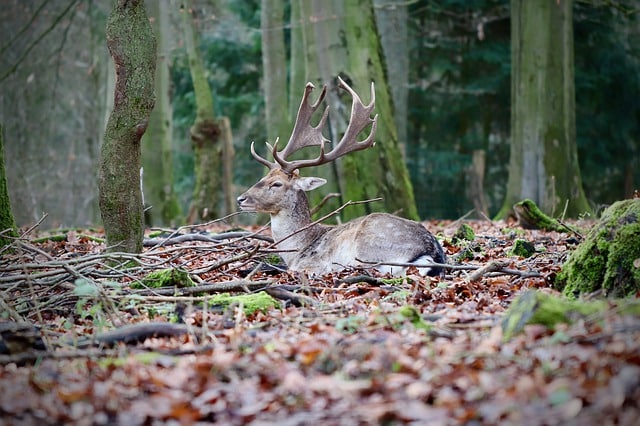
ADW records introductions to 38 countries, including North and South America, Australia, New Zealand, South Africa, and Fiji. Preferred ground is old deciduous woodland broken by grass, but they use mixed forest, scrub, and ranch pasture. They are a woodland-edge animal that also feeds in the open.
In the United States the two documented wild chapters are not equivalent. Texas Hill Country ranches hold free-ranging and high-fence fallow as exotic game; start the native-season half of that trip at Texas deer hunting. California’s chapter is Point Reyes National Seashore. The National Park Service traces a 1940s San Francisco Zoo origin, more than 860 fallow in the park by 2002, then culling and contraception that left a non-reproductive remnant. Axis were gone by early 2009. That is not a hunt.
Diet by season
Fallow are mixed feeders that can live on grass. The Mammal Society puts grasses at about 60 percent of the UK diet, with herbs and broadleaf browse, then acorns, chestnut, beech mast, and fruit in autumn. When grazing is short they take bramble and conifer. ADW lists grasses, mast, browse, herbs, buds, shoots, and bark. Peak feeding is dusk and dawn.
That grass habit is the management fact in Texas. Texas Parks and Wildlife ran food-habit work at Kerr Wildlife Management Area on axis, sika, fallow, blackbuck, and aoudad. Whitetails prefer forbs, shift to browse, and cannot live on grass. Fallow and the other exotics use forbs, browse, and grass. In the Kerr 96-acre pastures, six whitetails plus six of one exotic species finished with the exotics thriving and the whitetails dying after shared forage was gone. A Hill Country ranch stocked with fallow is not a neutral add-on to a native herd. Seasonal browse for the native animal is on what a white-tailed deer eats; the wider picture is what deer eat.
Reproduction and the rut
Northern Hemisphere mating runs from September into January, with peak fertilization in late October (ADW). Bucks hold small rutting stands: scrapes, thrashed cover, a low groan. At high buck density some populations lek — several males display on adjacent courts while does move through. That lekking is unusual among deer. Fights escalate from groaning and parallel walks to shoving with the palms. Injuries are rare. Does may cycle more than once; they usually conceive on the first cycle. See deer mating habits for the family pattern.
Gestation is about eight months. BDS gives 229 days; ADW 231–245. The usual litter is one fawn, born in June or July in the north, weighing about 2–4 kg (ADW) or 4–5 kg in some UK accounts. Twins are not the rule the way they are for a healthy adult whitetail — that contrast is on how many fawns deer have and deer gestation. The doe hides the fawn and returns to nurse. After two to three weeks the fawn follows her back into a female group. Weaning runs toward seven months. Fawns are spotted; common-morph adults may keep spots in summer, which is why a spotted adult is not automatically a fawn. Timing for native whitetail fawns is on when fawns lose their spots.
ADW: females first conceive around 16 months; males can breed at 17 months but usually not until about four years unless hunting pressure is high. Wild bucks commonly live 8–10 years (BDS; Mammal Society), sometimes 16; captive records on ADW run 20–25.
Antler cycle
Only bucks grow antlers. BDS’s UK cycle for fallow: cast April–May, velvet May–August, clean September–April. ADW: shed in April, hard and free of velvet by August. Older bucks tend to cast and clean first. Palmation is not a yearling trait. BDS: the flattened shovel generally appears on the third or fourth set and may take six or seven years to reach full size. Typical beam length is 50–70 cm (ADW), up to about 0.7 m (BDS). Velvet timing across species is on velvet shedding; year-to-year growth is on do antlers get bigger each year.
Predators and people
Where large carnivores still live, wolves, cougars, and bears take fallow (ADW). In Britain they have no wild predator that matters, which is why densities can climb until woodland regeneration fails. Does bark. Herds bunch. They pronk — all four feet off the ground, tail up — when they leave. Park animals can look tame. Wild animals are not.
People made the modern map. Medieval parks kept fallow for venison; later estates used them as ornament; farms raise them for meat. Texas landowners stock them as exotic game. TPWD names fallow beside axis, sika, elk, blackbuck, and aoudad: on private property there is no state bag limit and no closed season, but a hunting license and landowner permission are required. The native whitetail in the next pasture is still a tagged, season-limited animal. Public-land Texas hunting is mostly a whitetail problem; the state guide is Texas deer hunting.
Point Reyes is the other American lesson: a zoo-origin herd that competed with tule elk and black-tailed deer until NPS removed axis and contracepted the remaining fallow. Last NPS update on that page: 14 September 2024. If you are west of the Missouri and the lookalike is a native, you want mule deer vs whitetail, not this species.
Fallow vs other deer
Fallow cannot hybridize with whitetails. They can hybridize with Persian fallow, which is why breeding programs keep that endangered bloodline separate. A spotted adult that looks “in between” in Texas is a color morph, an axis, or a fawn that has not molted. Weights overlap with Hill Country whitetails; use the rack and the rump. Masses across species: how much does a deer weigh. Palmate vs flag-tail: fallow vs whitetail. Other spotted ranch deer: axis vs whitetail. Marsh and whistle: sika vs whitetail.
FAQ
Are fallow deer native to Britain or North America?
No. IUCN treats the only undoubtedly natural wild population as southern Turkey. Britain’s herds are an 11th-century reintroduction after Roman stock died out. North American herds are introductions: Texas ranches and the Point Reyes remnant.
Can fallow deer and white-tailed deer interbreed?
No. They belong to different subfamilies. There is no verified hybrid. A spotted adult next to an unspotted one in Texas is two species sharing a pasture. Details: fallow vs whitetail.
Why do some fallow deer look black or white?
Those are named morphs — melanistic and white — plus menil and common chestnut. They are the same species, maintained for centuries in European parks and still present in introduced herds. A black fallow is not a melanistic whitetail unless the antlers and rump say whitetail.
Can I hunt fallow year-round in Texas?
On private property, TPWD sets no closed season and no bag limit on exotic ungulates, and fallow are on that list. You still need a hunting license and landowner permission. The native whitetail on the same property is a different legal animal. Check the current Outdoor Annual.
How do I tell fallow from axis or sika?
Palmate antlers and a black-edged rump disk mark a mature fallow buck. Axis keep bright spots all year and grow three-point lyre antlers. Sika have a heart-shaped rump patch and a whistle, not a groan. Coat color alone is a trap: melanistic fallow look black; winter sika can look dingy. Use the rack and the rump.
What is a Persian fallow deer?
The larger, rarer cousin Dama mesopotamica, listed Endangered, now mainly a conservation story in Iran and Israel. Antlers are less palmate. The two forms interbreed, so captive programs keep them apart. Profile: Persian fallow deer.
Sources
- Masseti, M. and Mertzanidou, D. 2008. Dama dama. IUCN Red List 2008: e.T42188A10656554. Least Concern; native Turkish remnant under serious threat.
- Dharmani, A. 2000. Dama dama. Animal Diversity Web. Mass, height, antlers, pelage morphs, gestation, 38-country introductions.
- British Deer Society. Fallow deer and antler cycles.
- Mammal Society. Fallow deer. Most common deer in England; grasses about 60% of diet.
- Texas Parks and Wildlife Department. White-tailed deer vs. exotics (Kerr WMA) and exotic species.
- National Park Service. Non-native deer, Point Reyes. Last updated 14 September 2024.


