

Updated on September 7, 2026. A moose (Alces alces) is the largest living deer: a solitary northern browser with palmate antlers, a shoulder hump, and a dewlap. Alaska–Yukon bulls reach about 1,600 pounds. In Europe the same animal is called elk.
This is the species profile. The family index is deer species. Size numbers live on how much does a moose weigh and how tall is a moose. The elk mix-up is elk vs moose. State counts stay on moose population by state.
Moose facts (sourced)
| Scientific name | Alces alces (Linnaeus, 1758). Family Cervidae, New World subfamily Capreolinae, with white-tailed deer, mule deer, and caribou/reindeer. Not a close cousin of elk (wapiti). |
|---|---|
| Common names | Moose in North America. Elk in Europe and much of Asia. Maine DIFW traces the English word to the Algonquin moosu, “bark stripper.” |
| Size, Alaska–Yukon (A. a. gigas) | Adults from about 800 lb (small cow) to 1,600 lb (large bull); up to almost 6 ft at the shoulder. Rarely live more than 16 years in the wild. Alaska Department of Fish and Game, moose |
| Size, Yellowstone Shiras | Bulls close to 1,000 lb; cows up to 900 lb; 5½–7½ ft at the shoulder. Calves 25–35 lb at birth. The smallest of four North American subspecies. NPS Yellowstone, moose (updated Apr. 18, 2025) |
| Size, Maine eastern moose | Cows 3.5+ years average 836 lb. Prime bulls 5.5+ years average 1,106 lb. Largest harvested bull: 1,330 lb dressed, about 1,767 lb live. Antler spread rarely exceeds 65 in. Maine DIFW, moose |
| North America, circa 2025 | Survey range 910,494–1,423,044 animals (Nunavut excluded). USA 245,587–313,137; Canada 664,907–1,109,907. Alces 60(2), 2025 |
| Eurasia, circa 2025 | Europe excluding Russia 332,032–572,032; Russia 1,387,407; Eurasia excluding China, Mongolia, and Kazakhstan 1,719,439–1,959,439. Same paper. |
| Alaska herd and harvest | About 175,000–200,000 statewide, stable ±10% in the Alces census. At least 7,000 harvested a year, about 3.5 million lb of meat. ADF&G |
| Maine (Lower 48 high) | Highest moose count in the lower 48. Alces bin 25,000–50,000, stable. DIFW estimated about 76,000 in 2012; winter ticks have cut calf survival since. Harvest plus road kills 2,000–3,500 a year. Maine DIFW |
| Minnesota, 2026 aerial survey | 4,470 (95% CI 3,354–6,173) in the northeast survey area after a crash from about 8,000 in 2009. DNR frames the herd as fluctuating around 3,700. Minnesota DNR 2026 Aerial Moose Survey (12 Mar. 2026); moose management |
| Yellowstone herd | Fewer than 200 in the park. Down from roughly 1,000 in the 1970s. Northern-range fecal-DNA model 150–186 moose in 2013–2015. NPS Yellowstone |
| Conservation | IUCN Least Concern (Hundertmark, 2016 global assessment). Regional trouble is real: winter ticks, brainworm, heat, and calf predation. IUCN Alces alces |
| Official ID / hunt pages | ADF&G moose · Yellowstone moose · Maine DIFW moose · Minnesota DNR moose |
Those rows wear a source. Weights, state bins, and harvests are not a single “average moose.” Use the child pages for one-number questions. Confirm a tag on the state wildlife page for the year you are hunting.
How to tell a moose from elk, caribou, and a big deer
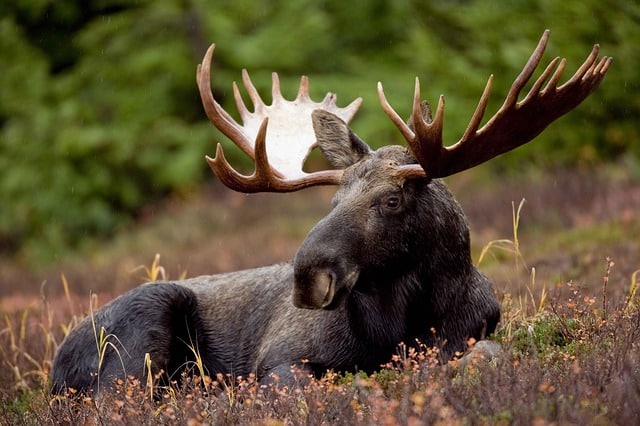
Shoulder height is the first tell. A Yellowstone bull elk is about five feet at the shoulder and about 700 lb. A Yellowstone bull moose is 5½–7½ feet before you count the hump, close to 1,000 lb. An Alaska bull can be 1,600 lb. A large Roosevelt elk can outweigh a small Shiras cow. It will not outweigh a prime Alaska bull. The ruler pages are how tall is a moose and moose size comparison vs other big deer.
Antlers only help on bulls, and only from late summer through winter. Moose paddles are flat, like an open hand. Elk racks are branched trees. Yearling moose can still look “elky”: Yellowstone yearlings grow 6–8 inch forked antlers before the palm fills in. Prime Yellowstone bulls reach about five feet tip to tip. Maine says a 55-inch spread is large and that a spread rarely exceeds 65 inches. Cows of moose and elk are antlerless. Then use the head: moose have a bulbous, overhanging muzzle and a dewlap (the “bell”). Elk have a narrower face, a dark neck mane, and a straw rump patch — the Shawnee/Cree “wapiti.” Moose run dark brown to nearly black; elk run tan to gold. Do not ID from color at dusk. The six-row split is elk vs moose.
A white-tailed deer is not in this size class. A northern buck is a 150–250 lb animal with a white tail flag and a round main beam. A moose calf in its first months can still be mistaken for a horsey deer at last light. Learn the silhouette before you hunt Superior or the Maine north woods. A mule deer is the western lookalike for elk, not for moose: big ears, black-tipped rope tail, stotting gait. You will not confuse a mule with a moose once the animal clears the willows.
Caribou and reindeer (Rangifer tarandus) are the other northern deer. They are herd animals. Both sexes can grow antlers. They are built for tundra and lichen, not for chest-deep lily pads. The compare is moose vs caribou. The Ice Age giant with the six-foot shovel rack is a different genus: Irish elk vs moose. If the question is only “is a moose a deer,” start at deer vs moose.
Tracks: moose leave a long heart with the tips often toed in. A prime Maine bull’s front hoof is about five inches wide; a cow just under four; a calf just under three (DIFW). Elk tracks are rounder. A whitetail print is smaller still. Sound is the night tell. Bull elk bugle. Moose grunt, bellow, and cough — what sound does a moose make.
Range: the boreal belt, not a backyard deer
Moose are a circumpolar forest animal. In North America they occupy Alaska and most of Canada south through the Rockies, the northern Great Lakes, and New England. In Eurasia they occupy Scandinavia, the Baltics, European Russia, and Siberia, with smaller or vagrant presence toward central Europe. IUCN’s 2016 global assessment lists the species as Least Concern. That listing is driven by the huge Russian and Canadian herds, not by Minnesota or New Hampshire.
The Alces 2025 census is the current continent-scale readout. North America sits in a 910,000–1.42 million band. Most Canadian and American jurisdictions were stable or increasing over the previous five years. Most European respondents were decreasing. Sweden, Norway, and Finland still harvest more moose than the rest of the reporting world combined — about 120,000 a year versus about 70,000 everywhere else in that survey — because calf recruitment there is high and hunting culture is different (party hunting, dogs, calf harvest). That is not a Lower 48 hunt plan.
Four living North American subspecies are the working field list, from Hundertmark and the agencies:
- Alaska–Yukon moose, A. a. gigas — the largest. ADF&G puts them from the Stikine north to the Colville. Southeast Alaska south of the Stikine is the exception: those animals are treated as western moose, A. a. andersoni, that walked down the Unuk and Stikine from Canada.
- Western moose, A. a. andersoni — British Columbia to Minnesota and western Ontario, plus northern Michigan.
- Eastern moose, A. a. americana — Maine and the Maritimes west through Quebec to central Ontario. Maine’s page uses americana.
- Shiras moose, A. a. shirasi — the smallest. Yellowstone’s page: forested areas and willow flats from southeastern British Columbia to southern Colorado.
Eurasian named races (European elk, Yakutia, Ussuri, Kamchatka) are real in the older literature. The Caucasian elk is extinct. Do not treat eight Latin names as eight huntable tags.
Where you actually see them in the Lower 48 is a short list. Maine is the honest viewing and lottery-hunt stronghold. New Hampshire, Vermont, and New York hold smaller, often tick-stressed herds. Minnesota’s northeast — Superior National Forest country around Ely and Grand Marais — is the Great Lakes holdout after a crash from about 8,000 in 2009. Michigan’s Isle Royale is a closed wolf–moose study, not a hunt. Montana, Idaho, Wyoming, Utah, Colorado, and Washington hold Shiras and mixed-mountain animals. Colorado’s 2025 tag sheet, cited on our elk compare, recommended 719 moose licenses against 130,300 elk licenses. That is the access gap in one number.
Seasonal movements are local, not a 500-mile caribou circuit. ADF&G: most Alaska moose move a few miles to as many as 60 miles between calving, rut, and winter range. Yellowstone moose that summer in the park may drop west and south to keep willow above the snow, or climb as high as 8,500 feet into mature subalpine fir. They are not following an elk herd down to Jackson.
Diet by season
A moose is a browser, not a grazer. The full menu is what does a moose eat. The family context is what deer eat. Elk eat grass. Moose eat wood, leaves, and aquatic plants.
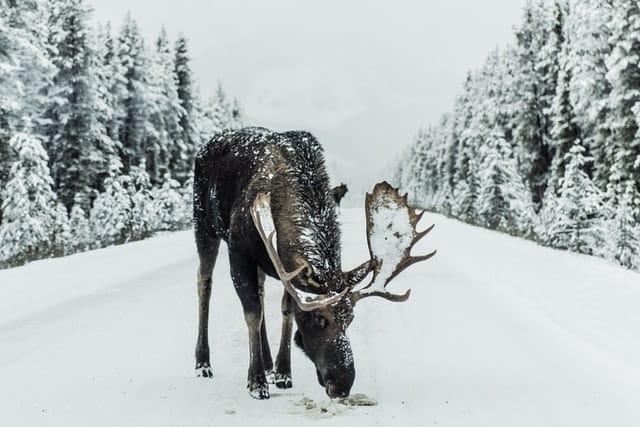
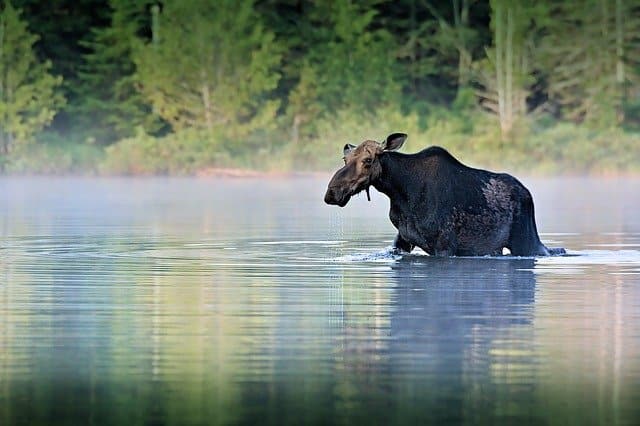
Yellowstone’s page is the cleanest seasonal split we have with numbers: aquatic plants in summer — water lilies, duckweed, burweed — then willow as the staple, then gooseberry and buffaloberry, then a winter preference for subalpine fir when it is there. An adult there eats about 10–12 lb a day in winter and as much as 50 lb a day in summer. Alaska moose hedge willow, birch, and aspen 6–8 feet off the ground. Maine lists willow, aspen, birch, maple, pin cherry, and mountain ash, plus balsam fir in winter that they cannot live on alone. Sodium is the summer reason they wade: pondweed and water lily beat woody browse for salt. Natural licks are rare in Maine, so moose use road salt. That is a collision problem, not a picnic.
They will put their head under. Hollow hair helps them float. They are not “the only deer that swims” — can moose swim is the dedicated page — but they use water as feed, heat dump, and insect relief in a way elk generally do not. In winter they take the woody browse line and, in deep snow, the packed snowmobile trail. Give them the trail.
Reproduction and calves
A female moose is a cow. A male is a bull. A baby is a calf. Those names, and why a group of moose is not a herd in the elk sense, live on what is a female moose called, what is a baby moose called, and what is a group of moose called. Moose are solitary or a cow with this year’s calf. You find one animal, not a hillside of them.
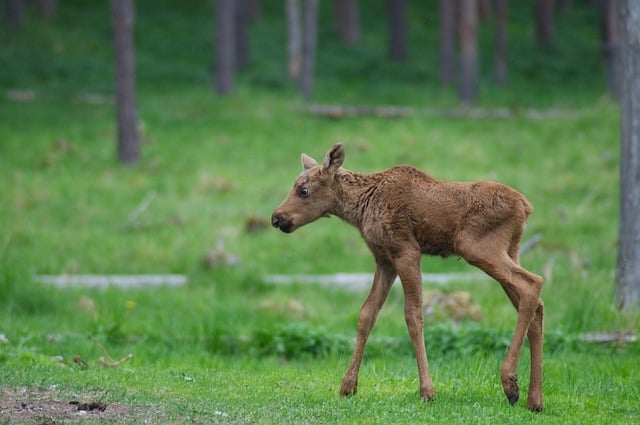
The rut peaks in late September and early October in Alaska and Yellowstone. Cows groan. Bulls grunt. Fights are usually a push; NPS notes a mortal wound is rare but real. ADF&G: a cow typically breeds at about 28 months, sometimes as early as 16. Gestation is about 230 days there, about eight months in Yellowstone. Calves drop in May and June. Alaska calves can weigh about 28 lb at birth and grow to roughly ten times that in five months. Yellowstone calves are 25–35 lb. Maine: cows may produce a first calf at two, most by three; one or two calves in May; twins track the cow’s body weight; young cows rarely twin.
The Alces 2025 census averaged 45.7 calves per 100 cows across reporting jurisdictions (range 10.5–81.4) and a 15.5% twinning rate (range 2.7–29.7). Isle Royale sat at 10.5 calves per 100 cows in that table. Scandinavia ran much higher, which is why those countries can harvest calves at a scale North America does not. Weaning in Alaska is fall, when the cow is breeding again. The yearling is chased off just before the next birth. That is why a May cow with a newborn is the animal that charges.
Antler cycle
Only bulls grow antlers in this species. Cows with antlers are extremely rare; Maine says so. That FAQ is do male and female moose have antlers — unlike reindeer, where females routinely carry them. Shed timing is when do moose shed their antlers. Beam size is how big are moose antlers.
Yellowstone: bulls usually drop in late December to late January; young bulls may keep them into March. New growth starts April or May as velvet-covered knobs, finishes by August, then the bull rubs the velvet off for the rut. Maine: antler bone can grow as much as eight inches in nine days; velvet sheds as testosterone rises in September; palms typically first develop at two and three; maximum development around age five; decline in the teens. Alaska: the largest racks usually come at 10–12 years, though a bull can reach trophy size by six. A pair of paddles is among the heaviest antlers of any deer. We do not invent an 80-pound pair without a specimen card.
After the rut the paddles are a winter tax. Shedding them saves energy. A January bull without antlers is still a moose: look at the muzzle and the bell. Maine notes some bulls grow a second skin tuft below the bell that can freeze off. Do not use that as an ID rule.
Predators, ticks, brainworm, and CWD
Wolves, black bears, and brown/grizzly bears are the named predators on the Alaska page. The overlap with deer country is real and lives on our wolves guide and top predators and threats to moose. Calves take most of the predation. Maine says natural predation on adults is low there because the local predators rarely kill a healthy adult; bears take newborns. Harvest and road kills still remove 2,000–3,500 Maine moose a year.
Isle Royale is the long experiment. The Alces 2025 table used 840 moose on the island, decreasing. Michigan Tech’s winter study, the longest-running predator–prey project in the world, has since reported still fewer moose and more wolves after the 2018–2019 translocation that rebuilt an inbred wolf population that had fallen to two animals. Read the current winter report before quoting a single year. The point for this page: wolves can limit moose where both are dense and the island has nowhere to go. Mainland Minnesota and Maine are not that island.
Parasites are the southern-edge story. The Alces census found winter tick (Dermacentor) in 20 jurisdictions and brainworm/tissue worm (Parelaphostrongylus / Elaphostrongylus) in 16. One-third of respondents said parasite impacts were increasing. None said they were declining. Maine’s page is blunt: winter ticks are not Lyme ticks. They do not spread a human disease. They attach by the thousands for five or six months and drain blood, strip hair, and kill calves. DIFW estimated about 76,000 moose in 2012; the herd is no longer that. An adaptive hunt in Wildlife Management District 4 is the state’s test of whether lowering density breaks the tick cycle. White-tailed deer carry brainworm without the same cost; in a moose it is often fatal. That is one reason high deer density in moose range is a management problem in Minnesota, not a bonus.
Chronic wasting disease showed up in two jurisdictions in that parasite table. We do not invent which two. If a moose looks skinny, drooling, or oddly tame, use CWD deer symptoms and the broader deer diseases page. CWD rules are state-specific. A moose is a cervid. Carcass transport bans that name deer, elk, and moose mean moose.
Climate sits under the ticks and the heat. Two-thirds of Alces respondents said climate was already hitting their top management concerns, mostly via parasites, body condition, and habitat. Moose dump heat poorly. A July afternoon on a logged Maine chopping is why they stand in ponds. That is also why the southern edge — Minnesota, New Hampshire, Massachusetts — is the place to watch, not the Kenai.
People: collisions, watching, and tags
A moose’s chest is windshield-high. The checklist after a strike is the same as for a deer — out of the lane, hazards, people first, do not walk up to the animal — on what to do if you hit a deer. A moose that is already closing is how to avoid and survive a moose attack, not a photo stop. NPS is blunt: moose, especially cows with calves, have chased people in Yellowstone. Are moose dangerous is the short answer page. They are not looking for you. They also do not leave the way a whitetail does. They stand, then they close. Speed when they do: how fast can a moose run.
Watching is a dawn and dusk job in willow, logged chops, and pond edges. Maine is the Lower 48 place to try; start at best place to see moose in Maine. Stay in the car if the animal is on the shoulder. Binoculars beat a phone zoom. Yellowstone viewing is southwestern willows and the Soda Butte, Pelican, Lewis, and Gallatin drainages, not a Lamar elk jam.
Hunting is almost always a limited draw outside Alaska. Alaska is the other end of the scale: 175,000–200,000 animals and thousands of harvests a year, including a subsistence share that is food, not a trophy story. That hunt sits next to Sitka blacktail on Alaska deer hunting — a deer license is not a moose tag. Maine’s lottery is the Lower 48 hunt people actually draw for; the deer page is Maine deer hunting. Minnesota’s northeast is moose country you share with a deer tag on Superior; ID the silhouette, then hunt deer on Minnesota deer hunting. Crown-land moose in Canada is a points system: Canada moose hunting spots and Ontario deer hunting. Tactics versus elk, pack-out, and why a moose is not an elk hunt live on moose vs elk hunting.
The ecological job — browse, seed, wolf food, indicator of a warming forest — is the moose’s role in ecosystems. Lifespan detail is what is the lifespan of a moose: ADF&G rarely more than 16; NPS up to 20; Maine averages eight years for a cow and seven for a bull, with animals rarely past 20.
FAQ
Is a moose a deer?
Yes. It is the largest living member of Cervidae. It sheds palmate antlers, ruminates, and belongs in the same family as elk, whitetail, mule deer, and caribou. It is not an elk, not a horse, and not a cow. Full answer: deer vs moose.
Why do Europeans call a moose an elk?
Because that was the English word for Alces before colonists in North America reused “elk” for wapiti. In Sweden or Siberia the big palmate deer is an elk. It is a moose. The North American elk is Cervus canadensis, closer to red deer than to moose.
Which moose is the biggest?
The Alaska–Yukon race, A. a. gigas. ADF&G: 800–1,600 lb, up to almost six feet at the shoulder. Maine’s eastern bulls average about 1,106 lb in their prime. Yellowstone Shiras bulls are close to 1,000 lb. Do not treat a Maine dressed-weight record as a typical bull.
Do moose live in the Lower 48?
Yes. Maine holds the most. Minnesota’s 2026 northeast survey estimated 4,470 after a crash from about 8,000 in 2009. Smaller herds occupy New England, the Rockies, and the northern Great Lakes. They are not in Texas, Florida, or California as a wild hunt.
Are moose aggressive?
They can be, especially a cow with a calf and a bull in late September. Yellowstone has documented chases. Give them room, stay off the calf, and do not crowd a roadside animal for a photograph. Detail: are moose dangerous.
Can I hunt moose on a deer license?
No. A deer tag is not a moose tag in Alaska, Maine, Minnesota, or any other jurisdiction we cover. Lower 48 moose is almost always a lottery. Read the state hunt page and the agency proclamation for the year you are going.
Sources
- Alaska Department of Fish and Game. Moose species profile. adfg.alaska.gov
- National Park Service. Yellowstone moose. Updated Apr. 18, 2025. nps.gov/yell
- Maine Department of Inland Fisheries and Wildlife. Moose. maine.gov/ifw
- Minnesota Department of Natural Resources. 2026 Aerial Moose Survey (12 Mar. 2026) and moose management. survey PDF · dnr.state.mn.us/moose
- Kramer, D. and Kalén, C. 2025. Population status of moose in North America and Europe – circa 2025. Alces 60(2): 1–23. alcesjournal.scholasticahq.com
- Hundertmark, K. 2016. Alces alces. IUCN Red List. Least Concern. iucnredlist.org
Parent hub: deer species. Siblings: elk, white-tailed deer, mule deer, reindeer.
Updated on September 7, 2026. Numbers in the facts table are tied to the linked agency and journal pages. We did not invent a global total that includes China, a 2026–27 tag quota, which two jurisdictions have CWD in moose, or an 80-pound antler pair without a specimen.


