The life cycle of deer begins in the fall during the rutting season, with gestation occuring during the winter months and the arrival of fawns in the spring. Spring is the best time for deer to bear young because the weather is beginning to warm up after the cold winter months, and food is just beginning to become abundant.
Female deer must have a plentiful and rich supply of food if she is to be able to produce enough milk for her young.
In this article I’ll answer the question “how do deer give birth?” and discuss the months leading up to and following deer giving birth to their young.
Gestation in Deer
For most deer species the length of the pregnancy, otherwise known as the gestation period, is anywhere between 200 and 250 days long.
This period can vary slightly for different types of deer, often reflecting the size of the deer (larger deer tend to have a longer gestation period).
How do Deer Give Birth?
Just before deer are due to give birth to their young, the females become increasingly restless and unable to settle down.
Females prefer to be alone in order to give birth and if they are living in a herd or with other deer they will leave them and find a quiet secluded spot where they can be on there own. Some deer leave their herds 2 to 3 days before they actually give birth.
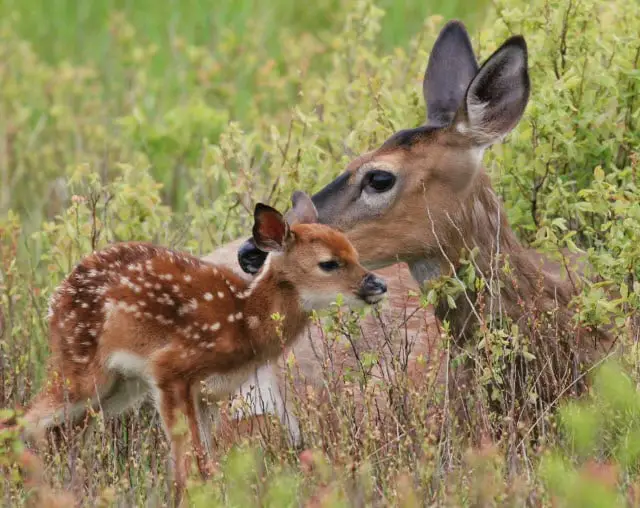
Female deer will often use areas of thick vegetation or undergrowth such as high grass stands or bracken in which to give birth. By doing this the female deer help to reduce the risk of predation to their young.
At the beginning of labor the vulva opens as the uterine fluids are released. While giving birth the female may stand and sit repeatedly, but when the young is actually on the way, most deer stand so that gravity will help the young emerge.
In nearly all deer births, the young is born head first, as if the fawn is diving toward the ground. After the young is born the female will lick it to clean it and dry it off.
Often, afterbirth will be delivered a half an hour after the birth, and most does will eat this for the energy it provides. By eating the afterbirth the female deer reabsorbs some of the valuable nutrients which it contains, and also lessons the risk of predators finding the young. The afterbirth it usually very bloody and would be very easy for a predator to find.
First Days After a Young Deer is Born
Young deer are generally well developed at birth, but are still extremely vulnerable to predators. They usually stand a few minutes after being born, and after a few hours are able to walk around.
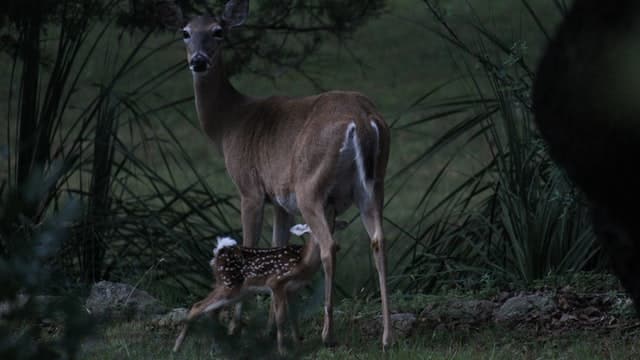
Often the mother will lead her new young away from the birthing area to a new uncontaminated area where there will be less chance of it being discovered.
The weight of newly born deer varies greatly depending on the species.
In the gigantic European Elk (Moose in America), the young can weigh over 10 kilograms at birth, and North American Elk can be quite large too. While the Southern Pudu, one of the smallest of the deer species, can bear young that weigh less than 350 grams at birth.
From a few days of age the young deer are able to run, but only for short distances. It is therefore necessary for them to find somewhere safe to hide from predators until they are able to accompany their mother.
How Baby Deer Hide Until They Gain Strength
The mother will remain with the young and suckle it every 2 or 3 hours during the first few days of its life. But thereafter she normally leaves it in a safe hiding place, normally amongst thick vegetation such as long grass or a dense stand of bracken.
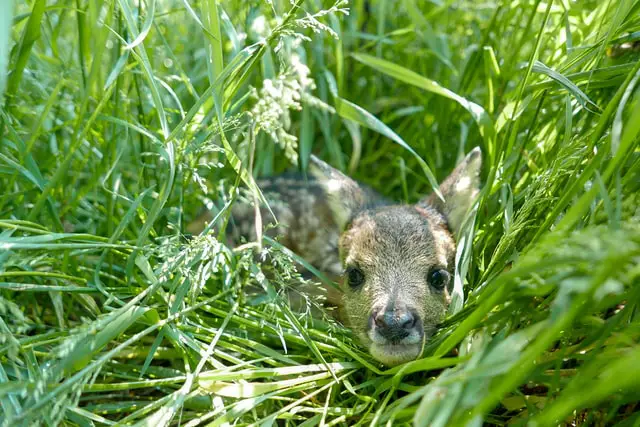
She can then go off and feed so that she can make more milk for the young.
If she remained with the young there might be the risk of her drawing the attention of predators to it, so it is probably better for her to retreat and let the young deer hide alone. While hiding the young remain perfectly motionless, often curled up in a tight ball. The mother returns to suckle its young several times a day until it is able to run well and is capable of joining the herd.
How Many Babies Do Deer Give Birth To?
In the Fallow Deer twins are fairly common. In this case instead of hiding together, the young hide separately, lying some distance away from each other.
By doing this the chance of each fawn’s survival increases. Even if a predator finds and kills one fawn, there is still a chance that the other may evade detection and survive. If they both hid together and were discovered they would both be lost to the mother. The mother does not want to place all her young ‘in one basket’.
Camouflage in Young Deer
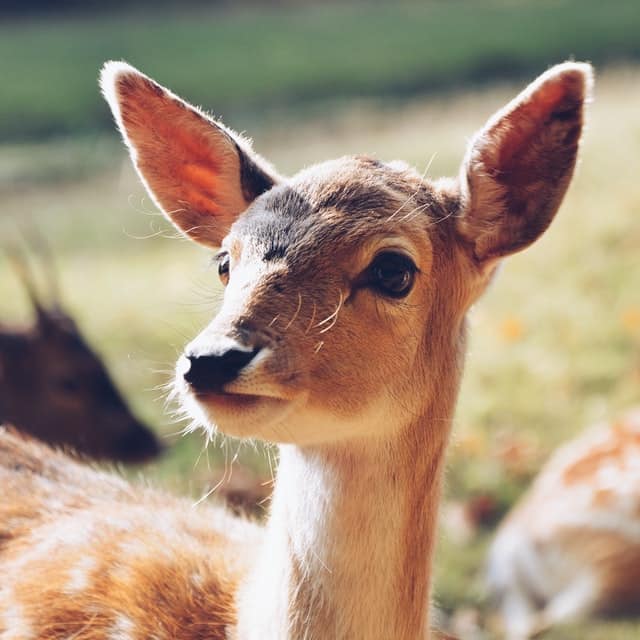
Young deer have spots or distinct white markings in many species. These white spots help to camouflage the young animal by breaking up its outline while it is hiding in long vegetation.
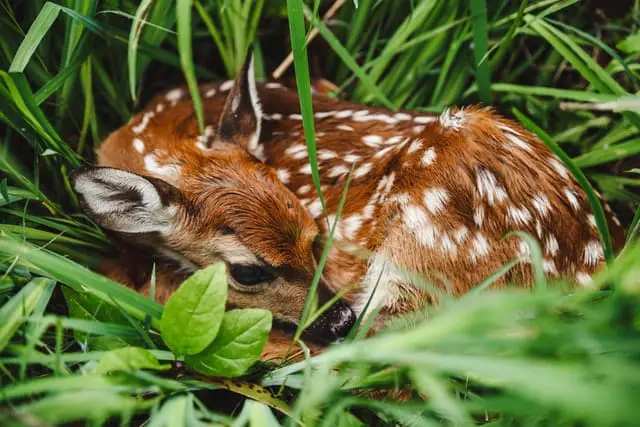
The white markings usually fade once the young animal is 2 to 3 months old. From this age the young are normally old enough to accompany the mother and no longer need the spots to camouflage them amongst thick vegetation.
What to Do if You Find a Baby Deer Alone?
When many people find a young deer they make the mistake of assuming it has been abandoned by its mother.
This is nearly always not the case.
The young deer is waiting, hidden, until its mother returns. When the mother comes back, she will feed and care for her fawn.
Anyone finding a young deer on its own should simply leave it. You should avoid touching the young deer as there is the danger that when the mother returns and smells foreign scents on her young she may abandon it.
As the Baby Deer Grows Up
For the first few weeks of its life milk from the mother is the only food the young takes.
But from about 2 weeks of age the young deer begins to take small amounts of green food.
From about a month of age the young feed more regularly and in greater quantity on green matter, but still rely to a high degree on the milk they receive from their mother.
Weaning begins at around 6 months of age. The number of times the young suckles each day declines, as does the quantity of milk the mother produces.
Although they are capable of living alone independently of their mother form about 6 to 8 months of age, the young usually remain with their mother until she gives birth to another baby deer. This is usually a year after they were born.
Sometimes when a female fails to conceive, the young from the previous year will remain with her for some months longer. Although in most species of deer the young reach sexual maturity at about 12 months of age, they do not normally breed until they are older. Females usually mate from 18 months of age while males may have to wait a number of years until they are strong and dominant enough to win the right to breed with females.