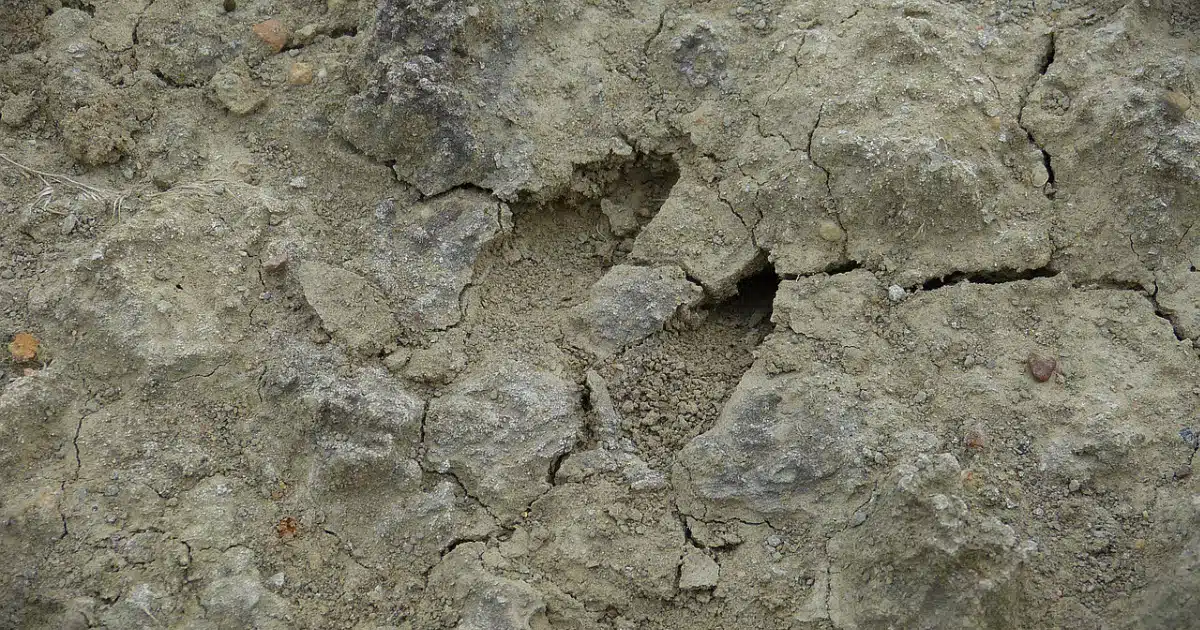
Deer walk on their hooves. These have two separate halves or cleats. If the deer walks over snow, or across muddy or sandy ground then imprints of its hooves will be left in the ground: deer tracks!
Although you may not see any living deer, it may be possible to know what species of deer live in an area by studying the tracks that they leave behind.
It is also possible to work out other things from the prints, for example how fast the animal was moving and the size and species of the deer from its hoof prints.
In this article I’ll provide photos of 9 different types of deer footrpints or tracks.
Then I’ll introduce you to the identifying characteristics of 4 different types of the most common deer tracks, and what you learn may help you to identify the deer walking through your forest or backyard.
Let’s start with some images of deer prints.
Pictures of Different Deer Footprints
Click on the deer tracks to learn more about each of these different types of deer.
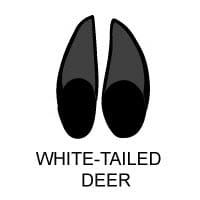

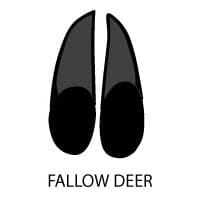
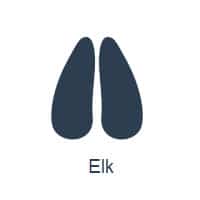
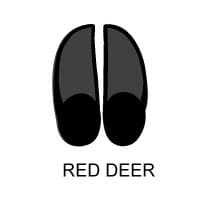
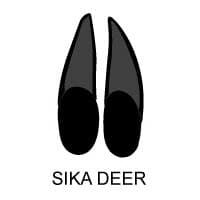

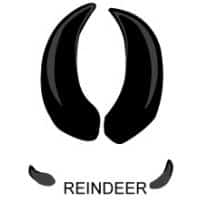
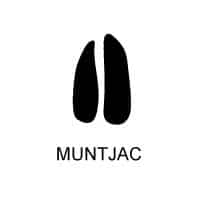
While every deer has hooves, the tracks of each individual species of deer is unique in terms of its shape and size.
And you’ll notice that some of the largest types of deer (Moose and Reindeer) have the pads from the back of their leg (just above their hoof) that will often touch the ground and leave small impressions behind the primary deer footprint.
Identifying Four Types of Deer Tracks
While this is in no way an exhaustive list, the characteristics defined for the 4 different types of deer prints below will help you to identify the type of deer that has left tracks in your path.
Let’s start with …
The Elk
The Elk leaves very large tracks corresponding to its large size.
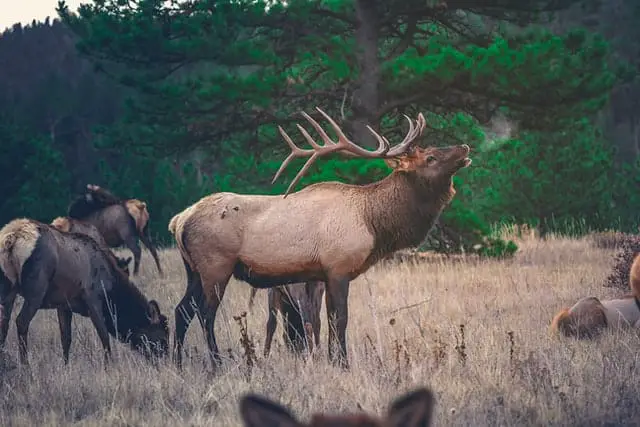
The hoof print left by a fully-grown male Elk is roughly 13 to 16 cm long and 11 to 13 cm in width. The prints left by the females and immature animals is smaller.
The front hooves of Elk are broader and more strongly imprinted than the hind hooves. The two cleats of the hooves are usually well spread out, an adaptation to the often damp and wet ground on which Elk live, and which helps to prevent it from sinking into soft ground. The dewclaws are often visible on the tracks of the hooves.
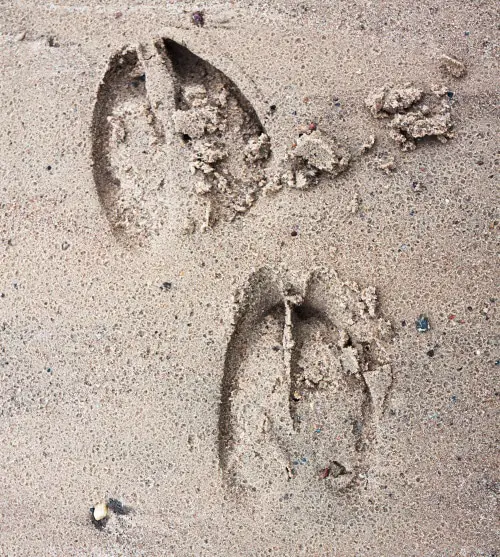
The Elk walks with a length of step of between 90 and 120 cm. As the Elk walks the hind hooves are placed in the tracks made by the front hooves.
When trotting the two cleats are often spread widely apart. Elk rarely gallop.
Reindeer
The hoof print left by the Reindeer reflects how it is adapted to living in the cold snowy north.
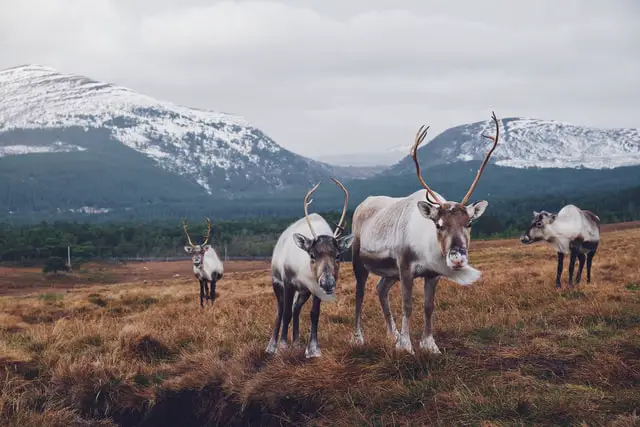
The cleats of the hoof leave a distinctive ‘half-moon’ track, together both cleats have a very rounded shape. The dewclaws are well developed in the Reindeer and are often visible on the hoof tracks. The length of the hoof print is between 8 and 10 cm, the width is between 8 and 11 cm. The female’s tracks are smaller and more pointed.
When walking at normal speed the hind hooves are placed in the tracks of the fore hooves. The length of step is about 100 to 120 cm long.
When the Reindeer is trotting the length of step increase, and the hoof prints lie in a line, but the hoof prints remain similar in appearance to when it is walking.
Red Deer
The Hoof print of the Red Deer is a broad oval shape, with parallel running cleats with blunt pointed ends.
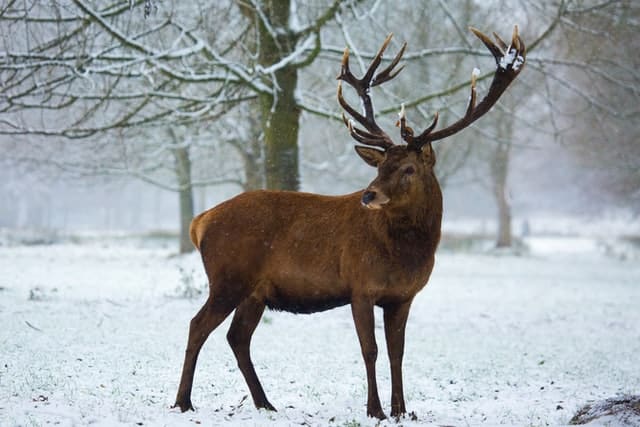
The fore hooves are roughly 7.5 to 9.5 cm long , and have a width of 6 to 7.5 cm. The hind hooves are noticeably smaller. The dewclaws are rarely seen as they are found high up on the leg of the Red Deer. The females hoof prints are smaller than those of the males.
When walking at normal speed the hind hooves are placed in the prints of the fore hooves.
When galloping the cleats are more widely spread out and the hoof prints spread over a wider distance.
Roe Deer
The Roe Deer has one of the smallest hoof prints of the native European deer species.
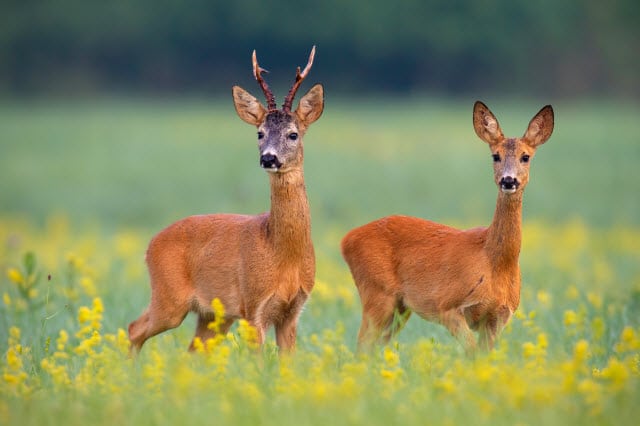
The cleats of the hooves make long heart shaped imprints on the ground that are between 4 and 5 cm long and about 3 cm in width. There is very little difference in size and shape between the males and females hoof prints. The dewclaws can sometimes be seen when the Roe is walking over damp ground.
The length of step is between 60 and 90 cm long. When trotting the hoof prints occur in a straight line.
When travelling at speed such as when fleeing the dewclaws become clearly visible. The frontal hooves become widely spaced when the roe is galloping.