In any discussion of deer mating habits, it’s important to note that different deer mate in different ways. But in general, most species of deer are polygamous. This means that one successful male mates with a number of female deer. In deer, as with most other mammal species, only a small proportion of the males mate with most of the females. Only the most dominant individuals get the chance to breed.
There are a number of different mating systems and deer mating habits, which I’ll discuss in this article. These include:
Harem Collection
During the rutting period males attempt to gather together a small group of females into a harem with which they can then breed as they become receptive. Elk are one species that do this.
Males in possession of a harem get challenged by other males who wish to breed with the female deer. The males can compete with each other in a number of ways including having bellowing contests and fighting with their antlers.
In the end the most dominant male deer wins possession of the harem.
Males with harems may have to fight rivals many times during the rutting season to maintain their control over their females.
The Red Deer is famous for its hotly contested rutting season.
Lekking
During the breeding season males congregate together at a small area of land known as the arena. Here the males compete with each other for control of small territories. The most dominant animals gain the best territories, which are usually in the middle of the arena.
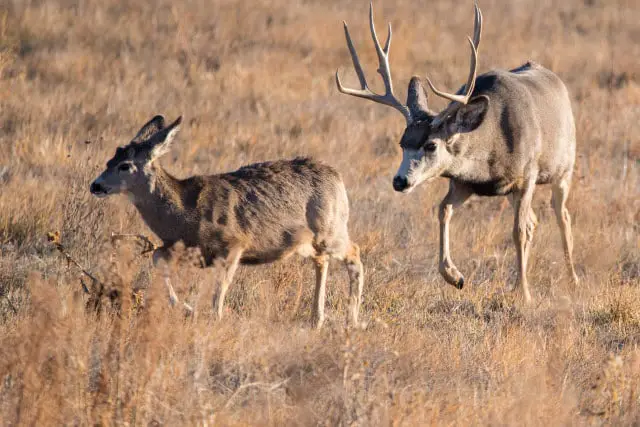
Lesser dominant males are often around the edges of the arena. When females are ready to be mated they then visit the lekking ground and go to the territories of their preferred male.
The females usually choose the most dominant males with the best territories.
Lekking is only seen in a few species of deer, such as the Fallow Deer.
Territorial Mates
In this type of mating system males possess permanent territories, these overlap with the territories of a number of females. When one of the females whose territory is within the males area is receptive then he mates with her.
Males compete for territories, with sometimes an incumbent male being usurped by a newcomer.
Competition also occurs between males at the edge of their territories, or over females whose territory overlaps with more than one males.
This type of mating system is seen in many of the Muntjac species of deer, such as the Reeve’s Muntjac. It is more common in those species that live in thick forest or woodland areas.
A Succession of Females
In some species, such as the moose, during the rutting period males mate with a succession of females. They will pair bond with a single females and then mate with her. When the female is no longer receptive the male will then search out another female with which to pair bond.
Successful males will mate with several females during the rut. Often there is fierce competition between males for access to a female, with long fights taking place.
The most dominant individual wins these fights and gains the right to pair bond and mate with the female.
Monogamy
Monogamy, where a male and female pair bond and mate together, is rare in the deer family.
The Chinese Water Deer may sometimes form pair bonds, both sexes possessing a small territory that they defend together.
Some of the Muntjac species are also sometimes monogamous.