Deer are the only animals to possess antlers. All species of deer have antlers in one form or another. Unlike horns, which are permanent structures, antlers are lost each year and regrown afresh. Although in Bovids both sexes can have horns, in the deer only the males possess antlers. The only exception to this is seen in the Reindeer, where the females also have antlers because they are useful to shovel snow away from the ground so the Reindeer can feed.
What is the Purpose of Deer Antlers?
Antlers are used by the male deer to compete with each other.

The males use antlers during the rutting period when they try to mate with females.
Males compete with each other and this competition can take various forms. For example males may use the antlers as weapons, locking them together to engage in a pushing contest as is seen in the Red Deer. They may also be used to stab an opponent.
With Antlers, Size Matters
However, antlers may not necessarily always be used to fight with. Often the strongest males who have had the best food resources grow the biggest and strongest rack.
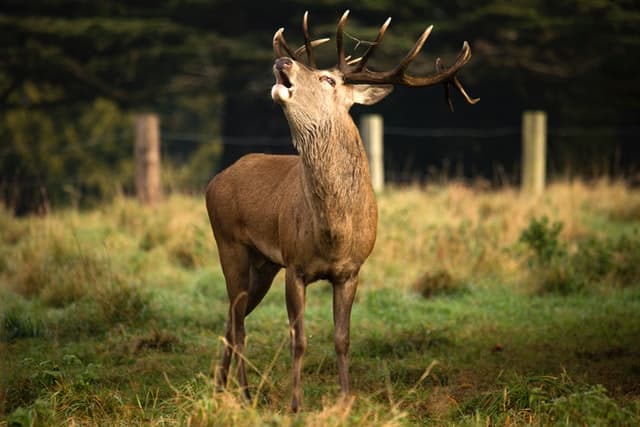
An opponent male seeing a male with a full head of antlers, may think twice about engaging in a fight. Why fight if you can tell instantly you are not strong enough?
There may also be the possibility that females in some species prefer males with the biggest horns. If this is so then such female choice would lead to the selection for larger and larger antlers in the male deer.
How Do Deer Antlers Grow?
On the top of the skull there is a bone core which is known as the ‘rose stock’ and it is from here where the antlers grow. There are two of these bone cores, with an antler growing from each one on deer.
The antlers are lost each year, normally after the rut has taken place, this is known as casting. Normally the antlers begin to regrow straight away.
Antler Velvet
As the antlers grow they are completely covered over with layer of skin. This is known as the velvet, it is soft and hairy.
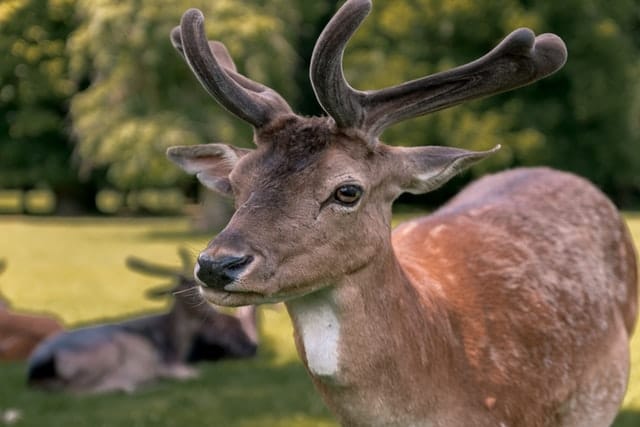
The velvet has a very good blood supply, and it is this which helps the antlers to grow, the antlers receiving nutrients through the blood.
The velvet acts to protect the growing antlers and to feed them. When the antlers reach there full size, the velvet beings to die away. It dries up and becomes flaky, and the antlers blood supply is lost.
Deer will normally rub the velvet off by rubbing the antlers on branches or tree trunks until it has all fallen off. This is called velvet shedding.
Antlers have a top layer that has small channels and small button like raised knobles known as Perling. The base of the antlers where the different branches join together into one single shaft is known as the ‘rose’.
In animals growing there first antlers the rose does not occur.
Nutrition Deer Need to Grow Antlers
To allow their new rack to grow, the deer needs a lot of calcium. The size that the antlers grow to depends on the mineral resources that are available to the deer in the area in which that deer lives.
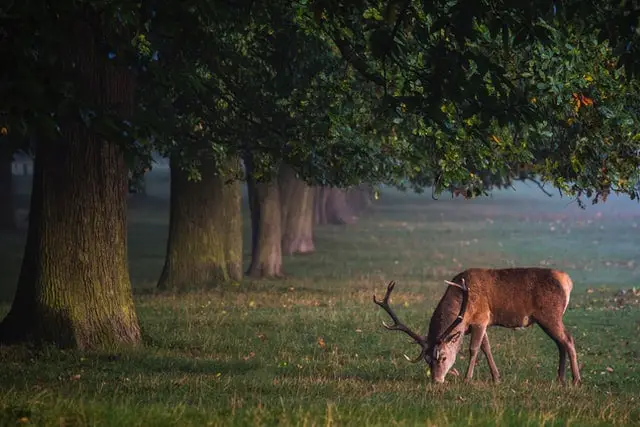
Deer use calcium in its bones, which has been stored up throughout the year, and this allows the antlers to be grown very quickly.
Normally the antlers get larger and have more tines as the deer gets older, but at a certain age deer antlers reach a maximum size, after which they become smaller each year.
Shedding Antlers
The antlers are lost each year. The antlers are lost when a small cavity forms beneath the rose, and the antlers break off.
The newly exposed bone of the rose stock is quickly grown over from the sides.
The Evolution of Antlers in Deer
It is easy to see how antler evolution took place, as there are a variety of different antlers shapes and sizes, with different levels of complexity in living deer species.
The simplest type of antler is the simple spike; this is seen in the Brocket deer, where the antlers are only short single sharp shafts, which grow to only 15 cm.
The next evolutionary step in antler development was the development of forking antlers, such simple forks can be seen in the Andean Deer, which have short antlers which have a single fork along there length and 4 tines or ends.
The next step was for there to be 2 forks in the antlers, with the rear fork, dividing again. This led to deer with 6 ends to there antlers, this type of antlers can be seen in species such as the Roe Deer and Axis.
Further forking led to antlers with numerous ends or forks, as is seen on species such as the Barasingha, which can have up to 20 tines.
Some deer grow broad palmate shaped antlers, such as the Moose and the Fallow Deer.
The Difference Between Antlers and Horns
You probably understand that when you compare horns vs antlers there are differences, but how exactly do antlers and horns differ?
This table will explain the differences between antlers and horns:
| Antlers | Horns | |
| Time Kept | Cast each year and grown anew | Remain throughout life without being lost |
| Form | Mostly branched | Unbranched |
| Number of ends or tines | Deer up to 26. e.g.Roe 6 (up to 8). | Always 2 |
| Substance made of | Bone, which is initially covered in velvet. | Horn |
The Growth of Antlers in Roe Deer (by age)
- Button spikes – In the autumn of the first year of the male Roe’s life 2 button like unbranched spike antlers grow from the skull. These are cast in the autumn.
- Spikes – In the spring of the following year, normally in February or March, two branch are grown, occasionally these have 2 ends or tines. These are cast in October.
- Forks – In the February or March of the 3rd year 2 forked branch form from the Rose. These are cast in October.
- 6 tines – In the February or March of the 4th year ( sometimes earlier), 2 additional tines are formed from each branch, meaning the roe now has 6 tines on its antlers. These antlers are cast in October.