The Barasingha deer (Rucervus Duvaucelii) is also called the swamp deer and it’s one of the most famed deer of the Indian subcontinent. You’ll find fragmented populations in both central and northern India, and there are two isolated populations of Barasingha deer in Nepal’s southwestern region.
Barasingha are now extinct in both Bangladesh, and in Pakistan (where it once lived).
One of the unique aspects of the swamp deer is that its antlers can have more than three tines, and its name translates from the Hindustani “barah-singga” (which means “twelve-horned” deer).
Mature Barasinga stags can have 10 to 14 tines on their impressive rack of antlers, with the most impressive stags carrying as many as 20.
How Big is the Barasinga Deer?
- Body & Head Length – up to 180 cm
- Shoulder Height – 115 cm
- Tail length – 12 to 20 cm
- Weight – up to 280 kg
Barasinga Physical Appearance & Identifiable Features
The name Barasingha is derived from the Hindu words for ‘twelve ends’, referring to this deer’s many tined antlers, which usually has 12 tines, but can have up to 20 in some animals.
The Barasingha is a high-legged deer, with a short head that has long broad ears. The hooves are long and broad. The summer coat is a yellowish brown colour, but in the winter months is darker in colouration. Some individuals have whitish yellow spots scattered over their coat. The hair around the neck can be longer, forming a shaggy mane; this is most noticeable in the winter months.
The Barasingha’s face has a dark mask. As mentioned the antlers have many tines. The antlers are cast mostly in February.
Rucervus Duvaucelii Habitat
Swamp deer, as their name suggest, are mostly found in marshy and damp areas, such as reed beds and marshes.
You’ll find Barasingha deer along rivers, and close to water. They can dwell in open parkland, but usually close to a source of water.
Where is the Barasingha Deer Located?
The Barasingha had a wide distribution across the whole of the Indian peninsula, however its populations have fallen because of habitat loss and over hunting.
The areas in which it lives, are often areas of potential agricultural value. Indian population increase has eliminated important habitat to make way for food production.
The Barasingha populations are now restricted to isolated and scattered locations in Nepal, Assam and the northern areas of India.
Unique Behavior of the Barasingha Deer
The Barasingha has a loud barking call which is used to signal danger, and which is similar to the roe deer‘s.
It feeds by day, but will rest during the hottest times. In winter large groups form, but in the summer these split into smaller herds composed mainly of females and their current young. At these times the males live separately from the females in small bachelor groups.
Barasingha are a very apprehensive and nervous deer, sensitive to disturbance, and easily spooked. They have a number of predators in the wild including the tiger.
Reproduction in Swamp Deer
Males have a very ritualized rutting behavior.
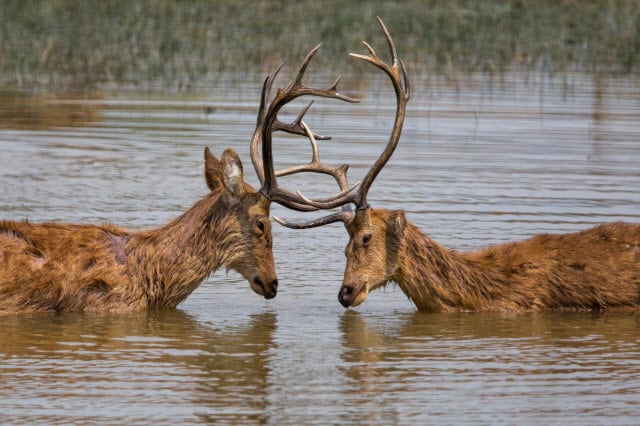
The rut starts in October. The males compete with each other to mate with female harems. Males fight by facing each other at a distance. Barasingha stags lower their antlers, pointing them directly at their opponent. They then often scrape the ground with their hooves, before racing at each other and clashing the antlers together.
Eventually one of the males will retreat, leaving the victor in possession of the female herd. The males have a distinctive 2 syllable rutting call.
Gestation in female Barasingha does lasts 240 to 250 days, and the females give birth to one or sometimes two young. The young are spotted, but the spots fade as the young grow, as is common in many deer species.
How Long do Barsingha Live?
Barasingha deer have a lifespan of up to 20 years.
What do Barasingha Swamp Deer Eat?
Barsingha eat predominantly wetland plants and herbaceous plants which are common in this deer’s natural habitat. They also graze on various types of grasses.
The Three Types of Barasingha
Not all barasingha are alike. Zoologists generally recognize three subspecies, each tied to a different landscape of the Indian subcontinent:
- Wetland barasingha (R. d. duvaucelii) — the swamp-dwelling form of the terai grasslands and floodplains of northern India and southwestern Nepal, with broad splayed hooves suited to soft ground
- Hard-ground barasingha (R. d. branderi) — a central Indian form, famous from Kanha, that lives on firm grassland rather than marsh and has more compact hooves
- Eastern barasingha (R. d. ranjitsinhi) — found in Assam in India’s northeast, principally in and around Kaziranga and Manas
A Famous Conservation Comeback
The hard-ground barasingha of central India is one of the best-known rescue stories in deer conservation. By the late 1960s this subspecies had been reduced to a single population in Kanha National Park, reported at well under a hundred animals. Decades of intensive management followed — grassland restoration, a predator-proof breeding enclosure, and strict protection — and the Kanha population recovered to several hundred deer. In recent years animals have also been translocated to establish additional populations in other central Indian reserves, spreading the risk beyond a single park.
The species as a whole is currently listed as Vulnerable on the IUCN Red List. Its numbers remain a small fraction of historical levels, and the surviving populations are isolated from one another, but strongholds such as Kanha, Kaziranga, and Dudhwa in India and Shuklaphanta in Nepal are actively protected. The barasingha also enjoys a special cultural status: it is the state animal of Madhya Pradesh, a distinction earned largely by the Kanha recovery.
Predators and How Barasingha Avoid Them
Sharing its range with India’s big carnivores, the barasingha is regular prey for tigers and, less often, leopards and dholes (Asiatic wild dogs). Fawns are vulnerable to a wider set of hunters, including jackals. The deer’s defenses are those of an open-country herd animal: many eyes and ears, that far-carrying alarm bark, and a readiness to plunge into tall reeds or shallow water where pursuit is difficult. Herd living is central to this — a lone barasingha is far more vulnerable than one standing among dozens of alert companions.
Barasingha vs. Sambar and Eld’s Deer
Within its Indian range the barasingha is most easily confused with the sambar, but the two are simple to separate: the sambar is darker, shaggier, and carries just three tines per antler, while a mature barasingha’s antlers branch into many more points. Its true closest relative in lifestyle and lineage is Eld’s deer of Southeast Asia — another swamp-adapted species with sweeping antlers. Both prefer wet grassland to closed forest, and both have paid for that preference, since wet grassland is precisely the deer habitat most easily converted to rice paddies and farmland.
Is the barasingha endangered?
The barasingha is currently classified as Vulnerable by the IUCN — not yet Endangered, but far from safe. It survives only in scattered, protected populations in India and Nepal, and it is legally protected throughout its range. The hard-ground subspecies of central India came close to extinction in the twentieth century before recovering under intensive management.
Where can you see barasingha in the wild?
Your best chances are in protected areas: Kanha National Park in Madhya Pradesh for the hard-ground form, Kaziranga National Park in Assam for the eastern form, and Dudhwa National Park in India or Nepal’s terai reserves for the wetland form. In these parks the deer are habituated enough to vehicles that good sightings are realistic.
What does the name barasingha mean?
It comes from Hindi and is usually translated as “twelve-horned” or “twelve-tined,” a reference to the mature stag’s many-branched antlers. Twelve points is typical, but exceptional stags carry more.
Related species: Meet the barasingha’s swamp-loving cousin Eld’s deer, the widespread sambar, and another grassland specialist of the subcontinent, the Indian hog deer.