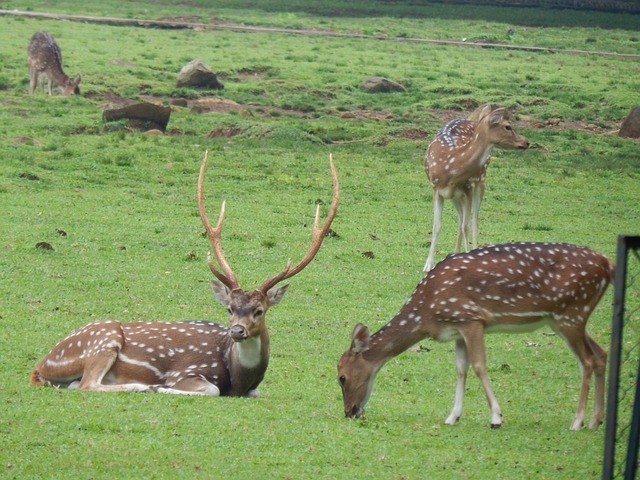
Updated on September 7, 2026. The axis deer, or chital (Axis axis), is a medium-sized spotted deer native to the Indian subcontinent. Adults keep white spots and a black dorsal stripe for life. In the United States it is a free-ranging exotic in the Texas Hill Country and on Maui, Molokaʻi, and Lānaʻi.
It is not a color phase of a white-tailed deer, and it is not a sika. The parent encyclopedia is deer species. Field splits that change an ID or a tag: axis vs whitetail and sika vs axis.
Axis deer facts
Numbers in this box wear a source. Confirm hunting rules on the agency page for the state you will actually hunt.
| Scientific name | Axis axis (Erxleben, 1777). Common names: chital, spotted deer, axis deer. Type locality: banks of the Ganges, India. |
|---|---|
| IUCN status | Least Concern (assessed 2014, published 2015). Wide native range and many large protected-area herds. IUCN Red List: Axis axis |
| Native range | India, Nepal, Sri Lanka, Bhutan, Bangladesh, and limited Pakistan. IUCN notes subpopulations over 20,000 around Corbett, Gir, Kanha, and the Nagarahole–Bandipur–Mudumalai belt. |
| U.S. free-ranging | Texas Edwards Plateau (core: Kerr, Bandera, Edwards, Real counties). Hawaii: Maui, Molokaʻi, and Lānaʻi. High-fence herds elsewhere. Not a wild animal in Maryland marshes. |
| Shoulder height | About 0.6–1.0 m (2–3.3 ft). Texas A&M puts a typical buck near 36 in (91 cm). |
| Weight | Texas ranch: bucks 145–250 lb (avg. ~160), does 95–145 lb (avg. ~100). Native-range adults commonly 45–85 kg, large bucks to ~110 kg. |
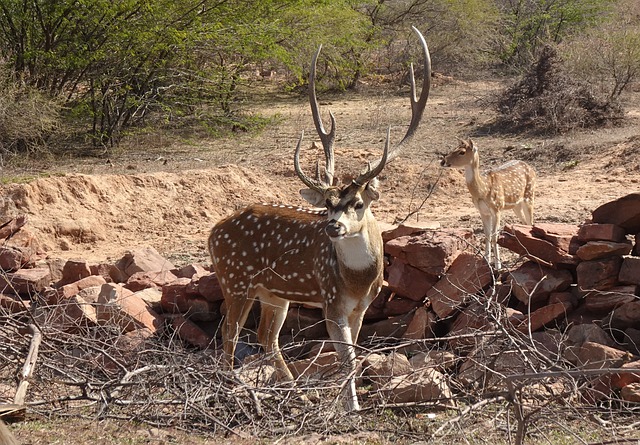
| Antlers | Bucks only. Lyre-shaped beam, normally three tines per side (brow + forked main beam). Typical beams ~70–80 cm; Texas trophy main beams listed 36–41 in. |
| Breeding | Year-round. Texas peak mid-May through August (June–July heaviest). Gestation 210–238 days. Usually one fawn; twins uncommon. Birth weight around 3.5 kg. |
| Diet | Grazer first: grasses year-round, then forbs, mast, and browse when grass is poor. Up to 160–190 plant species recorded in the native range. |
| Texas legal status | Exotic. Valid hunting license, landowner permission, no state closed season or bag on private land. TPWD Outdoor Annual, exotic rules (Sept. 1, 2026–Aug. 31, 2027). |
| Hawaii legal status | Game mammal on Maui Nui. Public hunts are island-and-unit tables. Private land: year-round with a Hawaii license and landowner permission. Hawaii DOFAW mammal hunting |
How to tell an axis from the lookalikes
The coat is the one-second ID. A living adult with a rufous-gold coat, rows of bright white spots, a black stripe from nape toward the tail, and a clean white throat is an axis. Adult whitetails are never spotted; their spots belong to fawns and fade. Do not “age” a spotted Hill Country deer as a fawn because the spots are still there. The full field split is axis deer vs whitetail.
A compact dark deer that flares a heart-shaped white rump is a sika. Sika spots fade in winter; axis spots do not. Maryland’s Eastern Shore is sika country. Axis are not a wild animal there. Where both share a Texas ranch, use geography, then the rump, then the rack: sika vs axis.
Fallow deer are the other spotted exotic on some Hill Country pastures. Mature fallow bucks grow palmate, shovel-shaped antlers. Axis grow a round lyre beam with three tines a side, never a palm. Fallow also come in black, white, and menil phases; axis stay rufous-spotted. The fallow–whitetail pair is on fallow vs whitetail.
The Philippine spotted deer (Rusa alfredi) is an endangered Visayan endemic, not a Texas ranch animal. Same-genus cousins — hog deer, Calamian deer, Bawean deer — are stockier and short-legged. Hog deer are Endangered; Calamian Endangered; Bawean Critically Endangered. Chital is Least Concern. “Spotted Asian deer” is not one conservation status.
Native range and the parks that still hold big herds
Chital occupy open woodland, sal forest edge, riverine forest, and short grassland from about 8° to 30°N. They avoid dense closed-canopy jungle and high mountains. In lowland Nepal (Bardia), they use riverine forest for shade and fallen fruit in the dry season and short grass for predator sight-lines. They need both: cover plus a graze they can watch.
IUCN lists the species as Least Concern because the range is still wide and several Indian conservation landscapes hold very large subpopulations: the Koh–Haldwani belt including Corbett Tiger Reserve (~3,000 km²); Gir (~1,400 km²); Kanha (~2,000 km²); and the Nilgiris–Western Ghats block of Nagarahole, Bandipur, and Mudumalai (~5,000 km²). It is protected under Schedule III of India’s Wildlife Protection Act, 1972, and under Bangladesh’s Wildlife (Preservation) (Amendment) Act, 1974. That is the opposite of a U.S. exotic: in its native range, chital is a protected prey species that feeds tigers.
It shares Indian floodplain and terai country with barasingha (swamp deer) and hog deer, and forest with sambar. Barasingha is a wetland grazer with a many-tined rack; sambar is a large dark browser; hog deer is a compact grassland specialist. Chital is the common spotted grazer in between.
How they reached Texas and Hawaii
Texas: Richard Friedrich released axis on Bear Creek Ranch, Kerr County, in 1932. The shipment landed at the Port of Houston with other exotics; some animals went to the San Antonio Zoo, some to the ranch. Floods washed out water gaps, and animals moved onto neighboring ranches. Friedrich later gave stock to the Y.O. Ranch. TPWD’s Kerr WMA research lists free-ranging axis, sika, fallow, and aoudad across large parts of Kerr, Bandera, Edwards, and Real counties. TPWD’s 1988 landowner survey already ranked axis the most numerous exotic (39,040 reported). There is no current public statewide census; ranch counts stay private.
Hawaii: eight animals (three bucks, four does, and a male fawn born at sea) arrived from Hong Kong as a gift to Kamehameha V and were released on Molokaʻi in January 1868. Twelve went to Lānaʻi in 1920. Maui releases began in 1959. There is no established wild herd on Kauaʻi (that island’s deer are Columbian blacktails) and no current public deer hunt on Oʻahu or Hawaiʻi Island. DOFAW estimated about 26,000 axis on Maui Nui in 2025. Most of those animals live on private ranchland. Trip planning belongs on Hawaii deer hunting, not on this profile.
Elsewhere, free-ranging or park herds exist in parts of Australia, Argentina, Croatia, and a few other countries. They are not cold-hardy. European attempts stay small because hard winters kill animals and damage growing antlers. That is why the U.S. strongholds are Hill Country and Maui Nui, not Michigan.
Diet by season
Chital are intermediate feeders that graze first. Across the native range, researchers have recorded 160–190 plant species. Green grass shorter than about 10 cm is preferred. In the monsoon they take grasses and sedges in sal forest. In the dry season they shift toward fallen leaves, flowers, fruit, and browse — including fruit dropped by Hanuman langur troops, a well-described mixed-species foraging association in Indian parks. Bucks will stand on their hind legs to reach overhead leaves.
In Texas they graze paspalum, switchgrass, and little bluestem, take sedges in spring, and browse live oak, hackberry, and sumac. They drink free-standing water daily in heat. Kerr WMA food-habits work is the practical U.S. fact: axis, sika, fallow, blackbuck, and aoudad prefer the same green forbs and browse that native whitetails want — and unlike whitetails, the exotics can shift onto grass when those forbs are gone. In high-fenced plots with no harvest, axis and sika outcompeted the native deer. That is why a Hill Country pasture with a free-ranging axis herd is not “just more deer.” Wild diet context: what do deer eat. On Maui farms and Hill Country yards the browse problem looks like suburban whitetails on hostas; start at do deer eat hostas if the question is a garden, not a tag.
They are social. Typical groups are a doe, this year’s fawn, and last year’s offspring. Sexually active bucks attach when a doe is receptive; other bucks form bachelor bunches. They feed in daylight more than a pressured Midwest whitetail, then loaf in shade through the heat. Dawn and dusk still matter. Deer feeding times is the general clock; axis do not punch a November rut card.
Reproduction: no November rut
This is the biology that makes the U.S. hunts unlike a whitetail season. Axis are polyestrous. The estrous cycle is about 18–21 days. Breeding can happen in any month. Texas A&M puts the typical Texas window at mid-May through August, peaking in June and July. Gestation is 210–238 days (AnAge average 226), so most Texas fawns drop January through March. Does usually produce one fawn a year. Twins happen; they are not the default the way they are in a well-fed northern whitetail doe. Mean birth weight in one Indian study was 3.53 kg (range 2.5–4.7 kg). Does can conceive at about 12–14 months; bucks around 14–16 months. Family-wide calendar: deer gestation and deer mating habits. The November story on the deer rut explained is for Odocoileus, not for chital.
Bucks do not hold a harem the way a red deer stag does. They tend receptive does as those does come into heat inside the herd. A hard-antlered buck, a velvet buck, and a recently shed buck can stand in the same group. The vocalization people notice is a bark — alarm, not a November grunt. Rutting bucks also bellow. Fawns squeal when separated. That bark is why ranch hunters call them watchdogs.
Antler cycle
Only males grow antlers. The typical hard rack is a 3×3: a forward brow tine, then a long main beam that forks. Beams are carried relatively low and sweep in a lyre. Shed-and-regrow is annual for an individual buck, but because breeding is not locked to photoperiod the way a northern whitetail’s is, there is no single statewide “they all drop in March” month. A Texas hillside in June can hold velvet and hard antler in the same herd. Trophy Texas main beams are listed in the mid-30s to about 41 inches; a typical Indian rack is closer to 70–80 cm. Velvet shedding and hard-antler timing follow that individual cycle, not a Wisconsin calendar. Family-wide velvet notes: deer velvet shedding.
Predators
In India, tigers take most of the adult chital killed by large carnivores. Leopards, dholes (Indian wild dogs), and jackals take fawns. Mugger crocodiles and pythons kill some animals at water. Asiatic lions take chital in Gir. That predator load is why the species can breed year-round and still not cover the subcontinent in a carpet. Hawaii has none of those predators. Fawn survival there is a management problem, not a tiger problem. Texas Hill Country has coyotes and the occasional mountain lion, not a tiger. USGS’s Hawaii ungulate fact sheet is blunt: high reproductive rates evolved under leopard-and-tiger mortality, then met islands with no equivalent.
Alarm is a bark plus a foot stamp. They do not flag a long white tail the way a whitetail does. They swim well enough to cross rivers in the native range. A general speed range for deer, not a chital lab trial, is on how fast can deer run.
People: protected in India, exotic in Texas, invasive game in Hawaii
In its native range, chital is a conservation success relative to many Asian deer on the endangered deer species list. Schedule III protection plus working parks is why IUCN still calls it Least Concern.
In Texas it is livestock-class exotic on private land: license, permission, no state season or bag. It is not a substitute for a native whitetail tag. County seasons still apply to whitetails. The hunt that holds both is Texas deer hunting. Kerr WMA work is why a landowner who wants native bucks has to treat axis as competitors, not scenery.
In Hawaii the same species is a game mammal and an island invasive. Herds browse native plants and crops and add fuel and erosion on overgrazed slopes. Public hunting is unit-specific; most animals sit behind ranch gates. Licenses, the Lānaʻi lottery, and Maui exhibits are on Hawaii deer hunting. Do not book Kona because a forum said “Hawaii deer.” Venison is a real market in both places. That does not make the animal native. Hunt it on the right license, and do not call a spotted adult a fawn.
Compares
- Axis deer vs white-tailed deer — spots, calendar, and the Texas tag split.
- Sika deer vs axis deer — Maryland marsh vs Hill Country gold.
- Fallow deer vs whitetail — palmate antlers, the other spotted ranch exotic.
- Sika vs whitetail — if the spotted deer is in Dorchester County, not Kerr County.
FAQ
Do axis deer keep their spots as adults?
Yes. White spots persist for life, with a dark dorsal stripe and a white throat. Adult whitetails do not keep spots. That is the ID.
Are axis deer native to Texas or Hawaii?
No. Native range is the Indian subcontinent. Texas stocking starts in 1932 in Kerr County. Hawaii’s founding herd was released on Molokaʻi in January 1868.
Is there a closed season for axis in Texas?
Not on private land. TPWD classifies axis as an exotic. You need a hunting license and the landowner’s permission. Native deer still follow county seasons. Confirm the current Outdoor Annual.
Do axis deer rut in the fall like whitetails?
No. They breed year-round. Texas activity often peaks June–July. A herd can hold hard antler and velvet in the same week.
How big is an axis compared with a Texas whitetail?
Overlap is real. Texas A&M lists axis bucks at 145–250 lb. Hill Country whitetails sit in the middle of the native size range. Coat, throat, dorsal stripe, and the 3×3 lyre rack separate them, not a bathroom scale.
Is a spotted deer in Maryland an axis?
Almost certainly not. That is sika country. Axis are Texas and Hawaii. Use sika vs whitetail on the Eastern Shore.
Sources
- IUCN Red List: Axis axis (chital) — Least Concern; native parks; Schedule III.
- Texas A&M Natural Resources Institute, Axis deer / chital fact sheet (Sept. 2025) — Texas weights, diet, May–August breeding peak, gestation.
- TPWD Outdoor Annual: nongame and exotic species — private-land exotic rules, license year 2026–27.
- TPWD Kerr WMA exotic research — Hill Country counties, diet overlap, competition with whitetails.
- Hawaii DOFAW game mammal hunting and DLNR axis deer impact survey, May 21, 2026.
- USGS Fact Sheet 2008-3102 — Hawaii introduction timeline and predator contrast.
- Animal Diversity Web: Axis axis — size, herds, vocalizations, Nepal habitat.
- Leslie, D.M. Jr. 2021. Axis axis (Artiodactyla: Cervidae). Mammalian Species 53(1008). — morphology, range, birth weights.